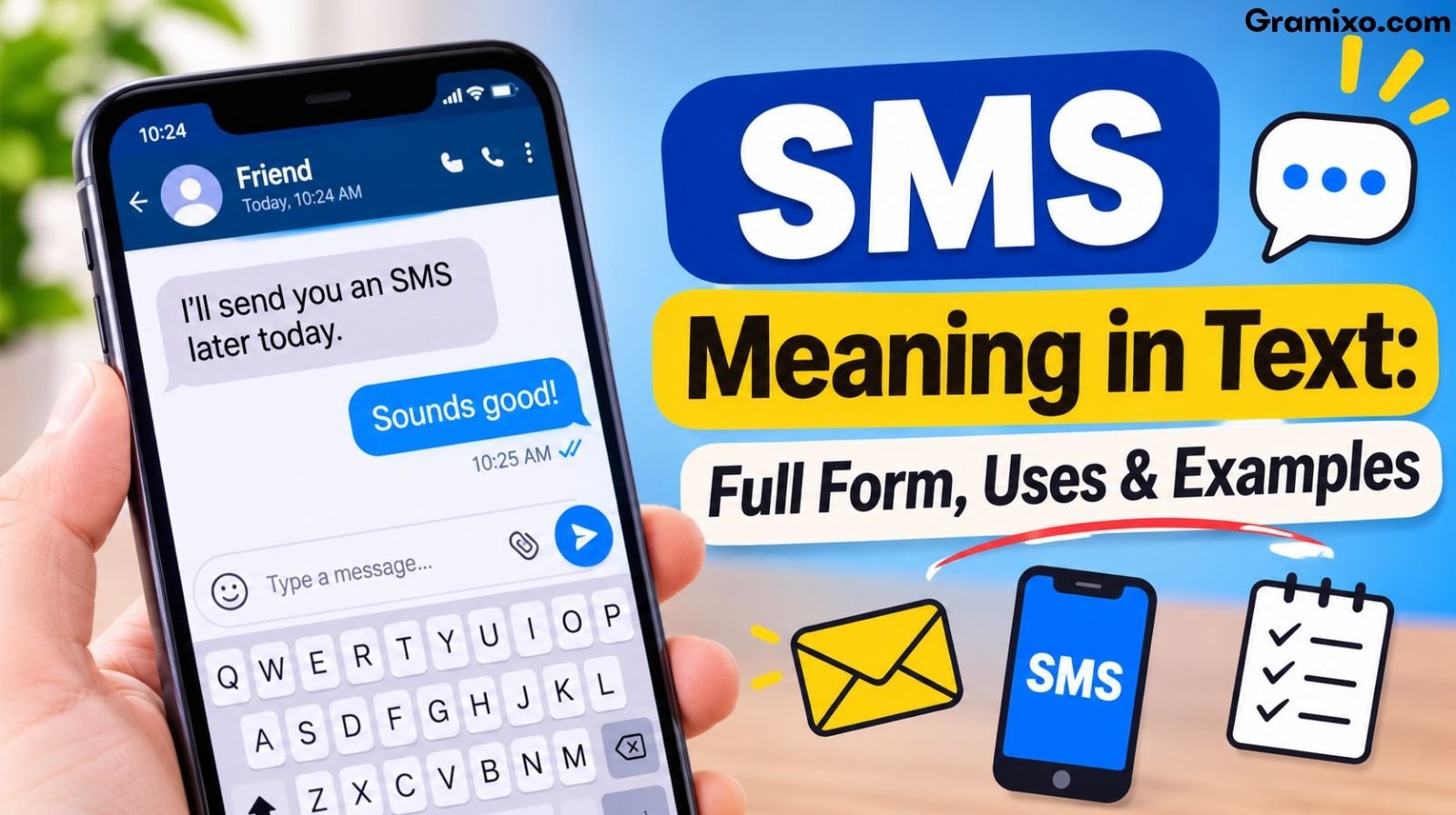
SMS Meaning in Text: Full Form, Uses & Examples If you’ve seen SMS in a message, phone setting, or online conversation, it usually refers to a text message sent through a mobile phone network. SMS stands for Short Message Service, a standard way to send short text messages between mobile devices.
For example, if someone says, “I’ll send you an SMS,” they mean they’ll send you a text message.
Unlike many internet abbreviations, SMS isn’t really slang. It’s a technical abbreviation that people commonly use in everyday conversations, mobile messaging, and phone settings.
Understanding its full form, common uses, and context will help you recognize what someone means whenever you see SMS.
What Does SMS Mean in Text?
The SMS meaning in text is Short Message Service, which refers to a standard text messaging service used to send short written messages between mobile phones.
People use SMS when they want to communicate without making a phone call or opening a messaging app.
Here are a few examples:
- “I’ll send you an SMS when I arrive.”
- “Did you receive my SMS?”
- “Check your phone. I sent you an SMS.”
In these examples, SMS simply means a regular text message.
You might also see someone use SMS as a verb. For example, “I’ll SMS you the details” means “I’ll text you the details.”
What Does SMS Stand For?
SMS stands for Short Message Service. It’s a mobile communication service that allows people to send and receive text messages using mobile networks.
Each word has a simple meaning:
- Short: Messages are designed to contain relatively brief text.
- Message: The written information sent from one person to another.
- Service: The mobile network facility that makes sending and receiving messages possible.
SMS became part of mobile communication standards and is still used for personal messages, business notifications, and verification codes.
Is SMS the Same as a Text Message?
Yes, in everyday conversation, SMS is commonly used to mean a text message.
However, there’s a small technical difference:
- SMS: The service or technology used to send a standard text message.
- Text message: The actual written message someone receives.
For example, when your phone displays “SMS sent,” it means your text message has been sent through the SMS service.
How Is SMS Used in Texting?
SMS is used in everyday communication when people want to send a message directly to someone’s phone number.
Unlike messaging services that require both people to use the same app, traditional SMS works through mobile networks and doesn’t require the sender and receiver to have accounts on the same messaging platform.
Common situations include:
1. Sending personal messages
Friends and family use SMS to share everyday information.
Example: “I’ll SMS you when I get home.”
2. Sharing important updates
People and businesses use SMS to communicate reminders, appointments, and other useful information.
Example: “The office will send you an SMS with the meeting details.”
3. Receiving verification codes
Websites and apps sometimes send one-time passwords (OTPs) through SMS to help verify a phone number or login attempt.
Example: “Your verification code has been sent by SMS.”
4. Receiving delivery notifications
Delivery companies may send SMS updates about parcels, estimated arrival times, or collection instructions.
Example: “I received an SMS saying my package is arriving today.”
5. Communicating without internet-based messaging apps
SMS can be useful when someone doesn’t have access to a messaging app or mobile data, provided their mobile network supports SMS.
What Does SMS Mean on Social Media?
On social media, SMS generally has the same meaning: Short Message Service.
It doesn’t usually represent a special slang expression or a different internet meaning.
People may mention SMS when discussing phone numbers, account verification, or moving a conversation from social media to regular texting.
For example:
- Instagram: “I’ll send you an SMS instead.”
- Facebook: “Check your phone for the SMS code.”
- Snapchat: “I don’t use Snapchat much. Just SMS me.”
- TikTok: “My verification code came through SMS.”
The meaning stays the same across these platforms. It refers to standard mobile text messaging rather than a direct message sent inside the social media app.
One thing to remember: An Instagram DM, WhatsApp message, or Snapchat message isn’t technically an SMS. These are messages sent through internet-based services.
Real-Life Examples of SMS in Text Messages
The easiest way to understand SMS is to see how people use it in normal conversations. Here are some original examples from everyday situations.
1. Between Friends
Friend 1: Are you coming to the party tonight?
Friend 2: Yes! I’ll send you an SMS when I’m leaving.
Meaning: The friend will send a regular text message before leaving.
2. Between Family Members
Mom: Let me know when you reach school.
You: Sure, I’ll send you an SMS.
Meaning: You’ll text your mother when you arrive.
3. At Work
Manager: Did you receive the updated schedule?
Employee: Yes, I got your SMS this morning.
Meaning: The employee received the schedule through a text message.
4. During Online Shopping
Customer: How will I know when my order arrives?
Support: We’ll send you an SMS with the delivery update.
Meaning: The company will send a text notification to the customer’s phone.
5. During Account Verification
Friend: Why are you checking your phone?
You: I’m waiting for an SMS verification code.
Meaning: You’re waiting for a security code sent through a text message.
6. Making Plans
Friend 1: I don’t have internet right now.
Friend 2: No problem. I’ll SMS you the address.
Meaning: The second friend will send the address through a regular text message.
7. A Quick Reminder
Sister: Did you remember the doctor’s appointment?
You: Yes, I got an SMS reminder yesterday.
Meaning: You received an appointment reminder through a text message.
8. Asking Someone to Text
Friend 1: Can you share the location?
Friend 2: Sure, SMS me your number.
Meaning: The friend is asking for a phone number so they can send a text.
What Is the Difference Between SMS, MMS, and iMessage?
SMS, MMS, and iMessage are all related to mobile messaging, but they don’t work in exactly the same way.
Here’s a simple comparison:
| Term | Full Form | Main Purpose |
|---|---|---|
| SMS | Short Message Service | Sending standard text messages |
| MMS | Multimedia Messaging Service | Sending pictures, videos, and other media |
| iMessage | Apple messaging service | Sending messages between supported Apple devices |
SMS: Used mainly for standard text messages through a mobile network.
MMS: Allows users to send multimedia content, such as photos and videos, through a mobile messaging service.
iMessage: Apple’s messaging service that uses an internet connection to send messages between supported Apple devices.
SMS and MMS are mobile messaging standards, while iMessage is Apple’s own messaging service.
Is SMS Formal or Informal?
SMS is neither slang nor an informal expression. It’s a widely recognized technical abbreviation.
You can use it in both casual and professional situations, depending on the sentence.
Informal usage:
- “I’ll SMS you later.”
- “Did you get my SMS?”
- “Send me an SMS when you’re free.”
Professional usage:
- “You will receive an SMS confirmation shortly.”
- “Your appointment reminder will be sent by SMS.”
- “Please check your phone for the SMS verification code.”
For formal writing, SMS is perfectly acceptable. However, if you’re writing for readers who may not recognize the abbreviation, spell out Short Message Service the first time you use it.
How Do You Reply When Someone Mentions SMS?
Your response depends on what the other person is asking.
If someone tells you they’ll send an SMS, you don’t need a complicated reply. A short, natural response is enough.
Here are some examples:
| Situation | Natural Reply |
|---|---|
| Someone says they’ll SMS you | “Okay, I’ll wait.” |
| Someone asks if you received their SMS | “Yes, I got it.” |
| Someone asks you to send an SMS | “Sure, I’ll send one.” |
| Someone says they sent a code | “Thanks, let me check.” |
| Someone asks for your number | “Sure, here’s my number.” |
| Someone promises to send details | “Sounds good!” |
You can also reply casually with:
- “Got it!”
- “No problem.”
- “Sure thing.”
- “Thanks for letting me know.”
- “I’ll check my messages.”
The goal is simply to respond to the actual message rather than focus too much on the abbreviation.
Common Misunderstandings About SMS
Although SMS is a simple term, people sometimes confuse it with other types of messaging.
Here are a few things worth understanding.
1. SMS isn’t internet slang.
SMS is a technical abbreviation, not a trendy expression like LOL, BRB, or IDK.
2. SMS and WhatsApp messages aren’t the same.
Both allow people to exchange written messages, but WhatsApp uses an internet connection, while traditional SMS uses a mobile network messaging service.
3. SMS doesn’t automatically mean a verification code.
An SMS can contain an ordinary conversation, reminder, notification, or security code. Its content depends on the sender.
4. SMS isn’t the same as MMS.
SMS is designed for standard text messaging, while MMS supports multimedia messages.
5. SMS isn’t always limited to one short sentence.
Traditional SMS has a standard 160-character limit for messages using the basic GSM character set. Longer messages can be divided into connected parts, and other character sets can change the limit.
Frequently Asked Questions
1. What does SMS mean in text?
SMS means Short Message Service. In texting, it usually refers to a regular text message sent through a mobile network.
2. What is the full form of SMS?
The full form of SMS is Short Message Service.
3. Is SMS the same as texting?
Yes, in everyday language, SMS is commonly used to describe texting. Technically, SMS is the service that delivers standard mobile text messages.
4. Is SMS considered slang?
No, SMS isn’t slang. It’s a technical abbreviation used in mobile communication.
5. What does SMS mean on WhatsApp?
SMS still means Short Message Service when mentioned on WhatsApp. It usually refers to a regular phone text message, not a WhatsApp chat.
6. What does SMS mean on Instagram?
On Instagram, SMS generally refers to a text message sent through a mobile network, often for verification or communication outside the app.
7. Can I use SMS in a professional message?
Yes. SMS is widely accepted in professional communication, especially for appointment reminders, notifications, and verification messages.
8. What is the difference between SMS and MMS?
SMS is primarily used for standard text messages, while MMS supports multimedia content such as pictures and videos.
9. What does it mean when someone says, “SMS me”?
It means “send me a text message.” The person wants you to contact them through a regular mobile text message.
10. Does SMS require Wi-Fi?
No. Traditional SMS doesn’t require Wi-Fi or mobile data, although it does require a compatible mobile network service.
Conclusion
The meaning of SMS in text is simple: SMS stands for Short Message Service, a technology used to send and receive regular text messages through mobile networks.
People use it for everyday conversations, verification codes, appointment reminders, delivery updates, and business notifications.
Although SMS sometimes appears in casual chats and social media conversations, it’s not internet slang. It’s a standard messaging abbreviation that remains useful in everyday communication.
So, whenever someone says “I’ll SMS you,” they’re simply saying they’ll send you a text message.
Discover More Article
- Strunk Meaning Slang: Is It Slang Or A Typo?
- IKTR Meaning in Text Messages: Examples & Context
- TW Meaning in Text: What It Really Means And How To Use It
- TM Meaning in Text: What It Really Means And How To Use It
- W Meaning in Text: What It Really Means In Chats & Social Media
- IFYKYK Meaning in Text: Simple Guide To “If You Know, You Know”
- RD Meaning in Text: Full Form, Chat Use & Examples
- TT Meaning in Text: What It Really Means In Chats & Social Media
Keep learning with more easy grammar lessons on: Gramixo.com

Hi, I’m Bilal Khalid, the founder of Gramixo. I’m passionate about helping people improve their English through clear, practical, and easy-to-follow grammar content. By combining my experience in SEO with a focus on creating helpful educational resources, I publish guides that simplify Grammar rules, explain common mistakes, and improve writing skills. Whether you’re a student, a professional, or an English learner, my goal is to make learning grammar easier, more enjoyable, and genuinely useful in everyday life.