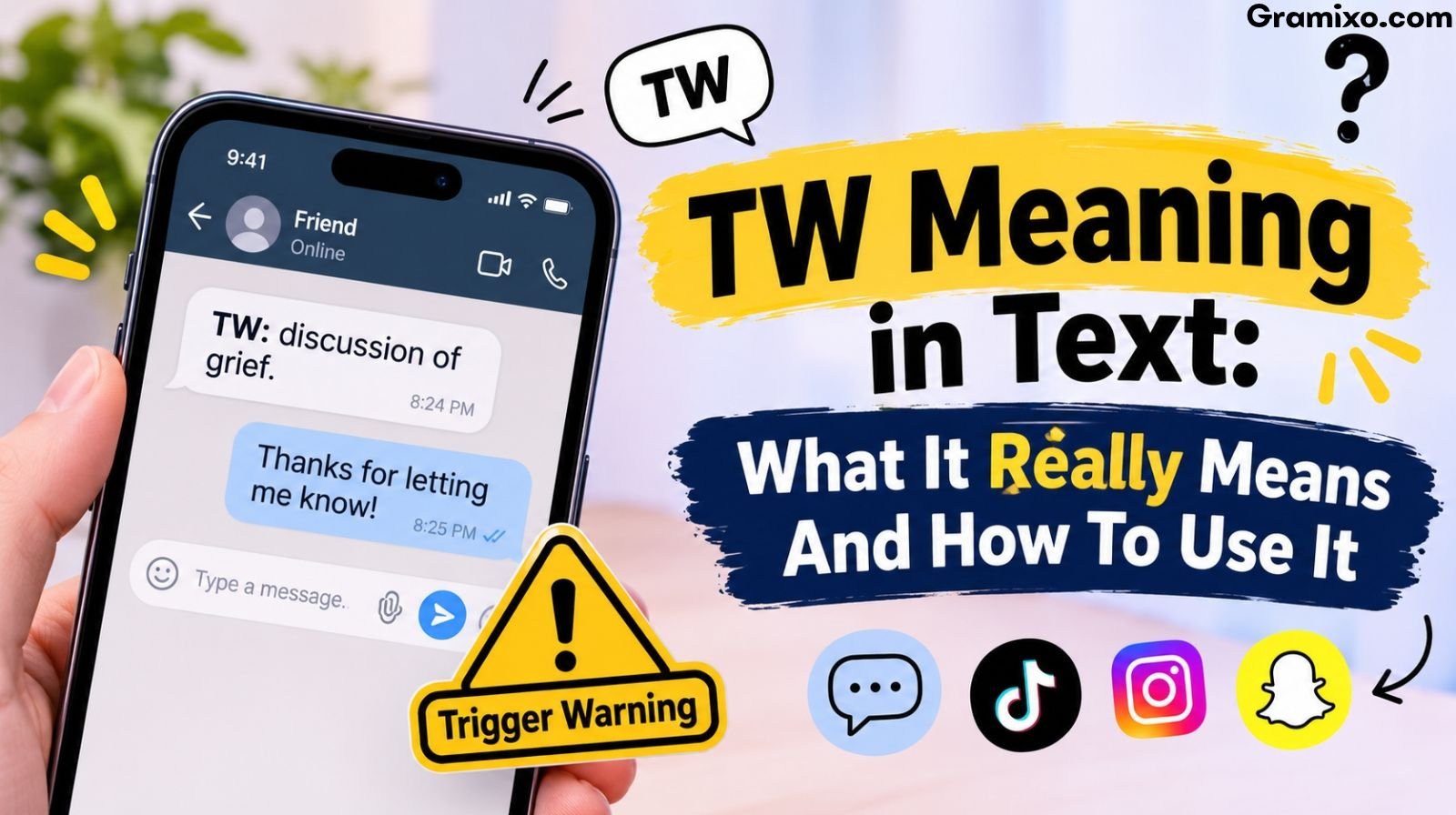
If you’ve seen TW in a text message, TikTok caption, Instagram post, or online discussion, it usually means Trigger Warning. People use it to alert others that the following content may include sensitive, upsetting, or emotionally difficult topics.
For example, someone might write, “TW: scary images” before sharing a disturbing picture. This gives readers a chance to decide whether they feel comfortable viewing the content.
TW is especially common in online conversations, social media posts, and content discussions. However, its exact meaning can depend on the situation. Understanding the surrounding message helps you interpret it correctly.
What Does TW Mean in Text?
TW stands for Trigger Warning. It’s a short notice that alerts someone before they encounter content that could be upsetting, uncomfortable, or emotionally difficult.
People usually place TW at the beginning of a message, caption, post, or video. They may use it when discussing subjects such as:
- Violence or physical abuse
- Mental health struggles
- Depression or suicide
- Eating disorders
- Death or grief
- Sexual assault
- Disturbing images or experiences
For example:
Friend 1: I want to share something that happened at the hospital.
Friend 2: Okay, what happened?
Friend 1: TW: medical details. It was a pretty difficult experience.
In this conversation, the sender uses TW to prepare the other person for a potentially upsetting discussion.
A trigger warning doesn’t mean that someone must avoid the content. It simply gives them a choice to continue, take a break, or skip it.
What Does TW Stand For?
TW is the shortened form of Trigger Warning. Both words have a specific purpose.
- Trigger: Something that may bring back a painful memory or cause a strong emotional reaction.
- Warning: An advance notice that helps someone prepare for what they are about to read, see, or hear.
Together, Trigger Warning tells people that the following content may be sensitive.
You’ll often see it written in these formats:
| Format | Example |
|---|---|
| TW: | TW: violence |
| tw: | tw: sad news |
| TW // | TW // discussion of abuse |
| Trigger Warning: | Trigger Warning: medical images |
All these formats communicate a similar message. Capitalization and punctuation don’t change the basic meaning.
How Is TW Used in Texting?
People use TW in private messages and group chats when they want to discuss something sensitive without surprising the other person.
Unlike everyday abbreviations such as LOL or IDK, TW isn’t mainly used to save typing time. Its purpose is to provide context before sharing difficult information.
Here are some common situations:
1. Before sharing personal experiences
Someone might use TW before talking about a painful event or difficult memory.
Example: “TW: grief. I’ve been struggling since my grandmother passed away.”
2. Before sending disturbing pictures
A person may give a warning before sharing an image that contains injuries, blood, or other graphic details.
Example: “TW: graphic photo. Don’t open the next message if you’re uncomfortable with that.”
3. Before discussing mental health
TW can introduce conversations about anxiety, depression, emotional struggles, or other sensitive subjects.
Example: “TW: depression. I’ve had a difficult few weeks and need someone to talk to.”
4. Before sharing upsetting news
People sometimes use it before discussing accidents, deaths, or other distressing events.
Example: “TW: accident details. The news from yesterday is really upsetting.”
In each situation, TW helps the reader understand the subject before deciding whether to continue.
What Does TW Mean on Social Media?
On social media, TW has the same meaning: Trigger Warning. However, its placement can change depending on the type of content someone is sharing.
Here is how it commonly appears across different platforms:
| Platform | How TW Is Used |
|---|---|
| TikTok | Before sensitive videos or discussions |
| In captions, Stories, and Reels | |
| Snapchat | Before sending sensitive pictures or messages |
| Before sharing difficult personal news | |
| Before upsetting posts or images | |
| Before discussions involving sensitive subjects | |
| Discord | Before potentially disturbing messages |
For example, a TikTok creator might add “TW: flashing lights” to a video’s opening text. An Instagram user might put “TW: grief” at the beginning of a caption.
The meaning doesn’t change between these platforms. The main purpose is to make the warning visible before someone encounters the content.
15 Real Examples of TW in Text Messages
The easiest way to understand TW is to see how people use it in everyday conversations. These examples show different situations where the abbreviation makes sense.
1. Talking About a Difficult Memory
Friend 1: Can I tell you something from my childhood?
Friend 2: Sure, I’m listening.
Friend 1: TW: family problems. It’s not an easy memory.
2. Sharing Medical Information
Friend 1: I have to tell you about my hospital visit.
Friend 2: What happened?
Friend 1: TW: medical details. It was a rough experience.
3. Discussing an Accident
Friend 1: Did you see the accident video?
Friend 2: No, what happened?
Friend 1: TW: graphic accident footage. I wouldn’t recommend watching it.
4. Talking About Depression
Friend 1: TW: depression. I’ve not been feeling like myself lately.
Friend 2: I’m sorry. Do you want to talk?
5. Sharing Sad News
Friend 1: TW: loss. My neighbor passed away yesterday.
Friend 2: That’s really sad. I’m sorry to hear that.
6. Posting on Instagram
User 1: I’m sharing my personal experience today.
User 2: What’s the post about?
User 1: TW: emotional abuse. Please read only if you’re comfortable.
7. Sending a Snapchat Story
Friend 1: TW: hospital pictures on my next story.
Friend 2: Thanks for letting me know.
8. Discussing a Scary Movie
Friend 1: TW: horror scenes in this movie.
Friend 2: Good thing you warned me!
9. Sharing Difficult News in a Group Chat
Friend 1: TW: upsetting family news. I need to share something with everyone.
Friend 2: We’re here for you.
10. Talking About Bullying
Friend 1: TW: bullying. Something happened at school today.
Friend 2: Are you okay? What happened?
11. Discussing Sensitive Topics on TikTok
Creator: TW: discussion of eating disorders. This video shares a personal experience.
Viewer: Thanks for adding a warning before the video.
12. Sharing a Personal Story
Friend 1: TW: past trauma. I’ve never really talked about this before.
Friend 2: Take your time. I’m listening.
13. Warning About Disturbing News
Friend 1: TW: violence. The news report includes some upsetting details.
Friend 2: I’ll skip that part. Thanks for the warning.
14. Discussing Pet Loss
Friend 1: TW: pet death. Our family dog passed away last night.
Friend 2: I’m so sorry. Sending you lots of love.
15. Sharing Sensitive Online Content
User 1: TW: disturbing images in the next post.
User 2: Thanks for giving everyone a heads-up.
These examples show that TW usually appears before the sensitive subject, not as a replacement for a complete sentence.
Is TW Formal or Informal?
TW is an informal internet abbreviation. It’s commonly used in texting, social media posts, online communities, and casual conversations.
It’s perfectly understandable in everyday digital communication, especially when someone wants to alert readers about sensitive content.
However, using only TW may not be suitable for every professional situation.
For example:
- Casual: “TW: upsetting news in my next message.”
- Professional: “Content warning: The following report includes descriptions of workplace harassment.”
- Formal: “Please be advised that the next section contains descriptions of violence.”
If you’re writing a professional email, academic paper, or official document, using the complete phrase “Trigger Warning” or “Content Warning” is generally clearer.
What Is the Difference Between TW and CW?
TW and CW are closely related, but they aren’t always used in exactly the same way.
TW (Trigger Warning) alerts readers about material that may bring back painful memories or cause a strong emotional reaction.
CW (Content Warning) is a broader label that identifies potentially sensitive, disturbing, or uncomfortable material.
Here’s a simple comparison:
| Abbreviation | Full Form | Main Purpose |
|---|---|---|
| TW | Trigger Warning | Alerts readers about potentially triggering content |
| CW | Content Warning | Alerts readers about sensitive or potentially upsetting content |
| NSFW | Not Safe For Work | Warns about content unsuitable for workplaces or public settings |
For example:
- “TW: discussion of sexual assault” highlights a potentially triggering subject.
- “CW: strong language” alerts readers to offensive or inappropriate language.
- “NSFW: explicit images” warns that the content may not be suitable for a workplace.
The labels can sometimes overlap, but they aren’t interchangeable in every situation.
Can TW Have Different Meanings?
Yes. Although Trigger Warning is the most common meaning of TW in texting and social media, the abbreviation can have other meanings in different settings.
Here are a few examples:
| Meaning | Context |
|---|---|
| Trigger Warning | Texting and social media |
| Taiwan | Country abbreviations and internet addresses |
| Terawatt | Science and electricity |
| Older online references |
For example, if someone writes “TW: discussion of violence” in a social media post, they almost certainly mean Trigger Warning.
However, if TW appears in a conversation about electricity, it may refer to terawatts, a unit of power.
Similarly, TW can refer to Taiwan in geographical or technical contexts.
The easiest way to understand it is to look at the surrounding words and the topic of the conversation.
How Do You Reply to TW in a Message?
If someone sends you a message starting with TW, you don’t need to give a complicated response. Usually, they’re simply giving you a warning before sharing something sensitive.
Your reply can depend on whether you’re comfortable discussing the topic.
Here are some natural responses:
| Situation | Possible Reply |
|---|---|
| Friendly | “Thanks for letting me know.” |
| Casual | “Okay, I understand.” |
| Supportive | “I’m here if you need to talk.” |
| Polite | “Thanks for the heads-up. I’ll keep that in mind.” |
| Uncomfortable | “I appreciate the warning, but I’d rather not read that.” |
| Curious | “What kind of content should I expect?” |
You can also choose not to continue reading or viewing the content. A warning gives you that choice, and you don’t have to explain your decision.
When Should You Use TW?
Using TW makes sense when you’re about to share something that some readers may find upsetting or difficult to process.
A few simple practices can make your warning more helpful:
- Put TW at the beginning of your message or caption.
- Clearly mention the sensitive topic after it.
- Give readers a chance to decide whether they want to continue.
- Avoid hiding the warning after the disturbing content.
- Keep the warning specific rather than using vague labels.
For example, instead of writing:
“TW: sensitive stuff.”
You could write:
“TW: discussion of grief and losing a loved one.”
The second version gives readers a much clearer idea of what to expect.
Remember, a trigger warning doesn’t guarantee that someone won’t feel upset. It simply provides advance information so they can make their own decision.
Frequently Asked Questions
Here are some common questions people ask about this abbreviation.
1. What does TW mean in texting?
TW means Trigger Warning in most texting and online conversations. It alerts someone that the next message or content may involve a sensitive or upsetting subject.
2. What does TW stand for in slang?
TW stands for Trigger Warning. Although it’s sometimes described as internet slang, it’s more accurately an online abbreviation used to introduce sensitive content.
3. What does TW mean on TikTok?
On TikTok, TW means Trigger Warning. Creators often use it in captions or video text before discussing sensitive topics or showing potentially disturbing material.
4. What does TW mean on Instagram?
On Instagram, TW is used to warn followers about sensitive content in posts, Stories, Reels, or captions.
5. What does TW mean on Snapchat?
On Snapchat, TW usually means Trigger Warning. Someone may send it before sharing a sensitive picture, video, or personal story.
6. Is TW a bad word?
No. TW isn’t an offensive word or an insult. It’s a warning abbreviation intended to give people advance notice about potentially upsetting content.
7. Is TW the same as CW?
Not exactly. TW means Trigger Warning, while CW means Content Warning. Both alert readers about sensitive material, but CW is generally a broader label.
8. Can I use TW in a professional email?
You can, but writing the complete phrase “Trigger Warning” or “Content Warning” is usually clearer and more appropriate in professional communication.
9. Does TW mean Twitter?
It can refer to Twitter in some older online contexts, but Trigger Warning is the more relevant meaning in modern texting and social media discussions.
10. How do I use TW in a sentence?
You can write: “TW: discussion of mental health. I’m sharing a personal experience that may be difficult for some readers.”
Conclusion
The TW meaning in text is usually Trigger Warning. People use this abbreviation before sharing sensitive, disturbing, or emotionally difficult content so others know what to expect.
You’ll commonly see it in WhatsApp messages, Instagram captions, TikTok videos, Snapchat stories, and online discussions. Although TW can have other meanings in different settings, Trigger Warning is the most common interpretation in everyday social media communication.
The next time you see someone write “TW” before a message, you’ll know they’re giving readers a heads-up. And if you use it yourself, remember to mention the sensitive topic clearly so people can make an informed choice.
Discover More Article
- 304 Meaning Slang: Definition, Context, Examples, And Modern Usage (2026 Guide)
- Restaurant Guru Meaning: Definition, Context, Examples, And Modern Usage (2026 Guide)
- YWS Meaning in Text: What It Could Mean, Examples, And How To Respond
- Strunk Meaning Slang: Is It Slang Or A Typo?
- TMP Meaning in Text: Why People Use It Online Today
- LDAB Meaning Slang: What Does LDAB Mean In Text & TikTok?
- IKTR Meaning in Text Messages: Examples & Context
Keep learning with more easy grammar lessons on: Gramixo.com

Hi, I’m Bilal Khalid, the founder of Gramixo. I’m passionate about helping people improve their English through clear, practical, and easy-to-follow grammar content. By combining my experience in SEO with a focus on creating helpful educational resources, I publish guides that simplify Grammar rules, explain common mistakes, and improve writing skills. Whether you’re a student, a professional, or an English learner, my goal is to make learning grammar easier, more enjoyable, and genuinely useful in everyday life.