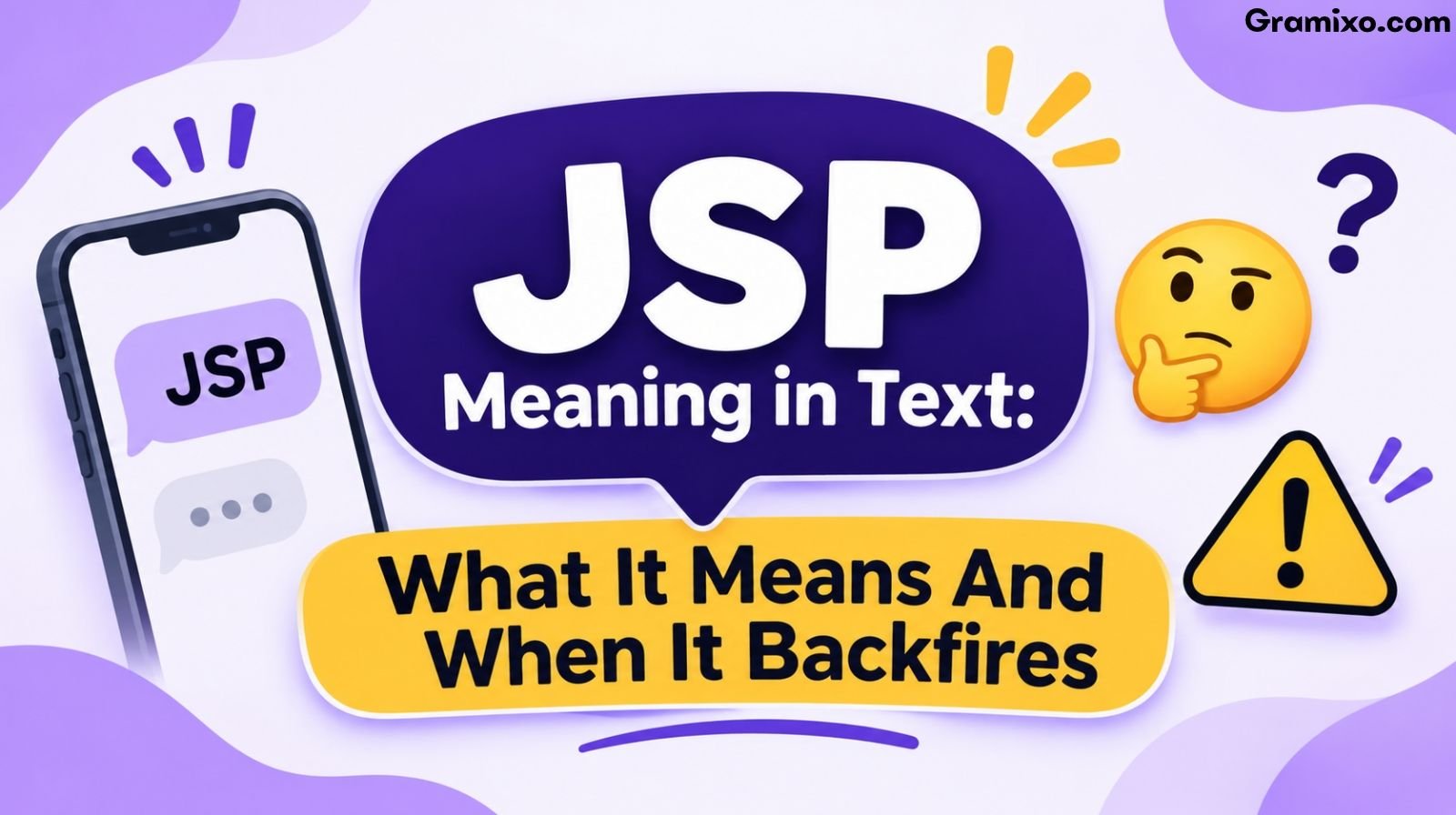
JSP Meaning in Text: What It Means And When It Backfires If someone sends you “JSP” in a text message, they may be telling you that they’re just playing around. In casual English texting, JSP commonly stands for “Just Playing.” It’s used after a joke, playful insult, or teasing comment to show that the sender isn’t being serious.
For example, someone might text, “You’re the worst teammate ever, JSP 😂.” They’re not actually insulting you; they’re trying to make the conversation playful.
However, JSP can be confusing because its meaning depends on the language and conversation. In French texting, for instance, it can stand for Je Sais Pas, meaning “I don’t know.”
There’s also one thing worth understanding: adding JSP doesn’t automatically make every joke funny or harmless. If a comment hurts someone’s feelings, saying “just playing” afterward can sometimes make the situation worse.
Let’s look at how people use JSP, what it means in different situations, and when you should avoid it.
What Does JSP Mean in Text?
JSP usually means Just Playing in casual English text messages and online conversations.
People use it to explain that something they just said was meant as a joke rather than a serious statement. It can make teasing feel lighter and help prevent someone from misunderstanding a playful comment.
For example:
Friend 1: You’re not invited to my birthday anymore.
Friend 2: Wait, what did I do? 😭
Friend 1: Nothing, JSP 😂
Here, JSP tells the other person that the birthday comment wasn’t serious.
You might see it after:
- A playful insult between friends.
- An exaggerated statement.
- A sarcastic comment.
- A funny threat that isn’t meant literally.
- A teasing message between people who know each other well.
The abbreviation is informal, so it’s more suitable for everyday conversations than professional communication.
What Does JSP Stand For?
In casual English texting, JSP commonly stands for:
JSP = Just Playing
It basically means “I’m only joking!” or “Don’t take it seriously.”
It’s similar to saying:
- I’m just kidding.
- I’m only joking.
- Don’t take it seriously.
- I’m messing around.
- I didn’t mean that literally.
Although Just Playing is a recognized interpretation in English-language chat, JSP isn’t a universally standardized abbreviation. Some people may use it differently, so the surrounding conversation matters.
How Is JSP Used in Texting?
JSP is generally used to change the tone of a message. Someone might make a statement that sounds serious, then add JSP to show that they’re joking.
Here are some common situations.
1. When Teasing a Friend
Friends often tease each other without having any intention of being hurtful. JSP can make that intention clearer.
Example:
Friend: You seriously can’t cook anything right.
You: That’s rude 😭
Friend: JSP, your food is actually good.
2. When Making a Joke
Someone may use JSP after making an exaggerated or unexpected statement.
Example:
Friend: I’m selling your gaming account tomorrow.
You: Don’t even think about it!
Friend: Relax, JSP 😂
3. When Using Sarcasm
Sarcastic comments can sometimes sound serious in text messages because readers can’t hear the speaker’s voice.
Example:
Friend: I finished the entire project without you.
You: Wow, you deserve an award.
Friend: You’re jealous, JSP.
4. When Keeping a Conversation Playful
JSP can also help maintain a relaxed atmosphere between people who regularly joke with each other.
Example:
Friend: You’re officially the slowest person in our group.
You: At least I’m not always late.
Friend: JSP, we’re both terrible at time management 😂
In each situation, the abbreviation helps communicate playful intentions.
What Does JSP Mean on Social Media?
On social media, JSP generally carries the same playful meaning as it does in regular texting. People may use it in comments, captions, private messages, and group conversations.
The platform doesn’t necessarily change its meaning. The surrounding message gives you the best clue.
Here are a few examples:
| Platform | Possible use |
|---|---|
| Snapchat | Adding JSP after a teasing snap |
| Making a playful comment in DMs | |
| TikTok | Clarifying a joking comment |
| Teasing friends in private chats | |
| Discord | Making jokes during group conversations |
| Adding humor to casual discussions |
For example, someone might comment, “Your dance moves need serious improvement, JSP 😂.”
They’re most likely joking rather than giving genuine criticism.
Can JSP Have Different Meanings?
Yes. JSP doesn’t always mean Just Playing. It can have different interpretations depending on the language and subject.
Here are three meanings worth recognizing.
1. Just Playing
This is a recognized meaning in casual English-language chats.
Example:
“You’re never getting my snacks again, JSP 😂”
The person is joking rather than making a serious statement.
2. Je Sais Pas
In French texting, lowercase “jsp” commonly stands for Je Sais Pas, which means “I don’t know” in English.
It’s similar to the English abbreviation IDK.
Example:
Person 1: Tu viens ce soir? (Are you coming tonight?)
Person 2: JSP, je te dirai. (I don’t know, I’ll tell you.)
This meaning is particularly important if you’re chatting with someone who speaks French.
3. JavaServer Pages
In programming and web development, JSP refers to JavaServer Pages, a technology used to build dynamic web content.
It has nothing to do with casual texting slang. The Jakarta Pages technology is its modern specification successor.
Quick tip: If someone uses JSP after a joke, Just Playing is a reasonable interpretation. If they’re answering a question in French, it probably means I don’t know. If they’re discussing coding, think of the technical meaning.
Examples of JSP in Text Messages
Seeing JSP in actual conversations makes its meaning easier to understand. Here are some original examples showing how people might use it.
Example 1: Talking With a Friend
Friend: You’re so annoying sometimes.
You: Thanks for the compliment 😂
Friend: JSP, you’re my favorite person.
Example 2: Playful Argument
Alex: I’m never talking to you again.
Sam: What happened now?
Alex: Nothing, JSP 😂
Example 3: Talking About School
Friend: You probably failed that test.
You: Why would you say that?
Friend: JSP, I’m sure you did fine.
Example 4: Gaming Conversation
Player 1: You’re getting kicked from the team.
Player 2: Bro, what did I do?
Player 1: JSP, you carried us last round.
Example 5: Family Conversation
Sister: I’m telling Mom you ate the last piece of cake.
Brother: Please don’t!
Sister: JSP, I already saved you another piece.
Example 6: Social Media Comment
Friend: Your new profile picture is terrible.
You: Seriously?
Friend: JSP 😭 It actually looks great.
Example 7: Casual Conversation
Friend: I think you’re secretly addicted to shopping.
You: That’s not true!
Friend: JSP, your delivery guy knows you better than I do 😂
These examples show that JSP is generally used to make teasing or exaggerated comments sound less serious.
When Does Using JSP Backfire?
This is where things get interesting. JSP is supposed to make a conversation playful, but it doesn’t always work.
Sometimes, adding “Just Playing” after an offensive or uncomfortable comment can make the situation worse.
1. When the Joke Hurts Someone
Imagine telling someone something personal and embarrassing, then adding JSP afterward.
Example:
Friend: Nobody likes your new hairstyle.
You: That actually hurts.
Friend: Relax, JSP.
The problem is that the comment has already hurt the other person. Adding JSP doesn’t automatically remove that feeling.
2. When You Make a Personal Joke
Not everyone feels comfortable being teased about their appearance, family, relationships, or personal struggles.
A joke that seems harmless to one person might feel disrespectful to another.
3. When You Use It During a Serious Conversation
Imagine someone is discussing a genuine problem, and you respond with a sarcastic comment followed by JSP.
They might feel that you’re not taking their situation seriously.
It’s better to understand the mood before using casual slang.
4. When You Use It to Avoid Apologizing
JSP shouldn’t become an excuse for saying something hurtful.
If someone tells you that your comment upset them, acknowledge their feelings instead of repeating that you were only playing.
A better response would be:
“Sorry, I didn’t mean to hurt you. I was joking, but I understand how it sounded.”
That’s more respectful than simply saying “JSP.”
Is JSP Formal or Informal?
JSP is an informal texting abbreviation. It’s mainly suitable for relaxed conversations with friends, family members, and people who understand your sense of humor.
It isn’t a good choice for professional emails, official messages, academic writing, or serious workplace discussions.
| Situation | Should you use JSP? |
|---|---|
| Texting close friends | Yes |
| Casual WhatsApp chats | Yes |
| Instagram DMs | Yes |
| Gaming conversations | Yes |
| Professional emails | No |
| Job applications | No |
| School assignments | No |
| Formal business messages | No |
If you want to communicate the same idea more clearly, use phrases such as:
- Just joking.
- I was only kidding.
- I didn’t mean that seriously.
- I was only teasing you.
These alternatives are easier to understand, especially when you’re communicating with someone unfamiliar with texting slang.
How Do You Reply When Someone Says JSP?
Your response depends on what the person said before using JSP.
If they’re making a harmless joke, you can respond playfully. If the comment feels disrespectful, you don’t have to pretend that it was funny.
Here are some natural replies.
Casual replies:
- “Haha, I knew it.”
- “Okay, you got me.”
- “I figured you were joking.”
Funny replies:
- “Not funny, but I’ll allow it 😂”
- “You almost got me!”
- “I was about to block you.”
Friendly replies:
- “Haha, you’re too much.”
- “It’s all good.”
- “I know you’re playing.”
If the joke hurts your feelings:
- “I know you’re joking, but that wasn’t cool.”
- “Please don’t joke about that.”
- “I understand, but I didn’t like that comment.”
You don’t need to respond with another abbreviation. A simple, natural message is perfectly fine.
JSP vs. JK: What’s the Difference?
JSP and JK are similar because both can help communicate that someone isn’t being serious. However, their wording is different.
| Abbreviation | Full form | Meaning |
|---|---|---|
| JSP | Just Playing | I’m teasing or joking around |
| JK | Just Kidding | I didn’t mean that seriously |
| LOL | Laughing Out Loud | Something is funny |
| IDK | I Don’t Know | I don’t have the answer |
| TBH | To Be Honest | I’m expressing an honest opinion |
The biggest difference is that JSP emphasizes playful behavior, while JK directly tells someone that a previous statement was a joke.
For example:
JSP: “You’re the worst player on this team, JSP 😂.”
JK: “You’re the worst player on this team, JK 😂.”
Both can communicate humor, although the exact tone depends on the conversation.
Frequently Asked Questions
1. What does JSP mean in text messages?
JSP commonly means “Just Playing” in casual English texting. People use it after jokes, teasing comments, or exaggerated statements to show that they aren’t being serious.
2. What does JSP stand for in texting?
In English-language casual texting, JSP can stand for Just Playing. It is an informal abbreviation used to communicate playful intentions.
3. Is JSP a slang word?
Yes. When used to mean Just Playing, JSP is an informal texting abbreviation or internet slang expression.
4. Does JSP mean Just Saying?
Some people may interpret JSP as Just Saying, but this isn’t as consistently established as Just Playing. Check the surrounding message before assuming that meaning.
5. What does JSP mean on Snapchat?
On Snapchat, JSP can mean Just Playing. Someone may add it after a joke or teasing message to make their intentions clearer.
6. Is JSP rude?
Not necessarily. It is usually playful, but the original comment can still be hurtful. Adding JSP doesn’t guarantee that the other person will find the joke funny.
7. What does JSP mean in French?
In French texting, JSP stands for “Je Sais Pas,” meaning “I don’t know.” It’s commonly used as a short version of the phrase.
8. Can I use JSP in professional messages?
It’s better to avoid it in professional communication. Write “I was just joking” or explain your meaning in complete words instead.
9. Is JSP the same as JK?
They’re similar but not identical. JSP means Just Playing, while JK means Just Kidding. Both can be used to clarify that a message wasn’t serious.
10. What should I reply when someone sends JSP?
If the person is joking, you can reply with “Haha, I knew it” or “You almost got me.” If the comment bothers you, explain that politely.
Conclusion
JSP commonly means Just Playing in casual English texting. It’s a simple way to show that a comment was meant as a joke, tease, or playful statement rather than something serious.
You’ll likely encounter it in text messages, Snapchat conversations, social media comments, and online chats.
However, remember that context matters. JSP can also mean Je Sais Pas in French texting or refer to JavaServer Pages in programming.
Most importantly, don’t assume that adding JSP makes every joke harmless. A little humor can make conversations enjoyable, but knowing when to stop teasing makes communication much better.
Discover More Article
- IKTR Meaning in Text Messages: Examples & Context
- TW Meaning in Text: What It Really Means And How To Use It
- TM Meaning in Text: What It Really Means And How To Use It
- W Meaning in Text: What It Really Means In Chats & Social Media
- IFYKYK Meaning in Text: Simple Guide To “If You Know, You Know”
- RD Meaning in Text: Full Form, Chat Use & Examples
- TT Meaning in Text: What It Really Means In Chats & Social Media
- SMS Meaning in Text: Full Form, Uses & Examples
Keep learning with more easy grammar lessons on: Gramixo.com

Hi, I’m Bilal Khalid, the founder of Gramixo. I’m passionate about helping people improve their English through clear, practical, and easy-to-follow grammar content. By combining my experience in SEO with a focus on creating helpful educational resources, I publish guides that simplify Grammar rules, explain common mistakes, and improve writing skills. Whether you’re a student, a professional, or an English learner, my goal is to make learning grammar easier, more enjoyable, and genuinely useful in everyday life.