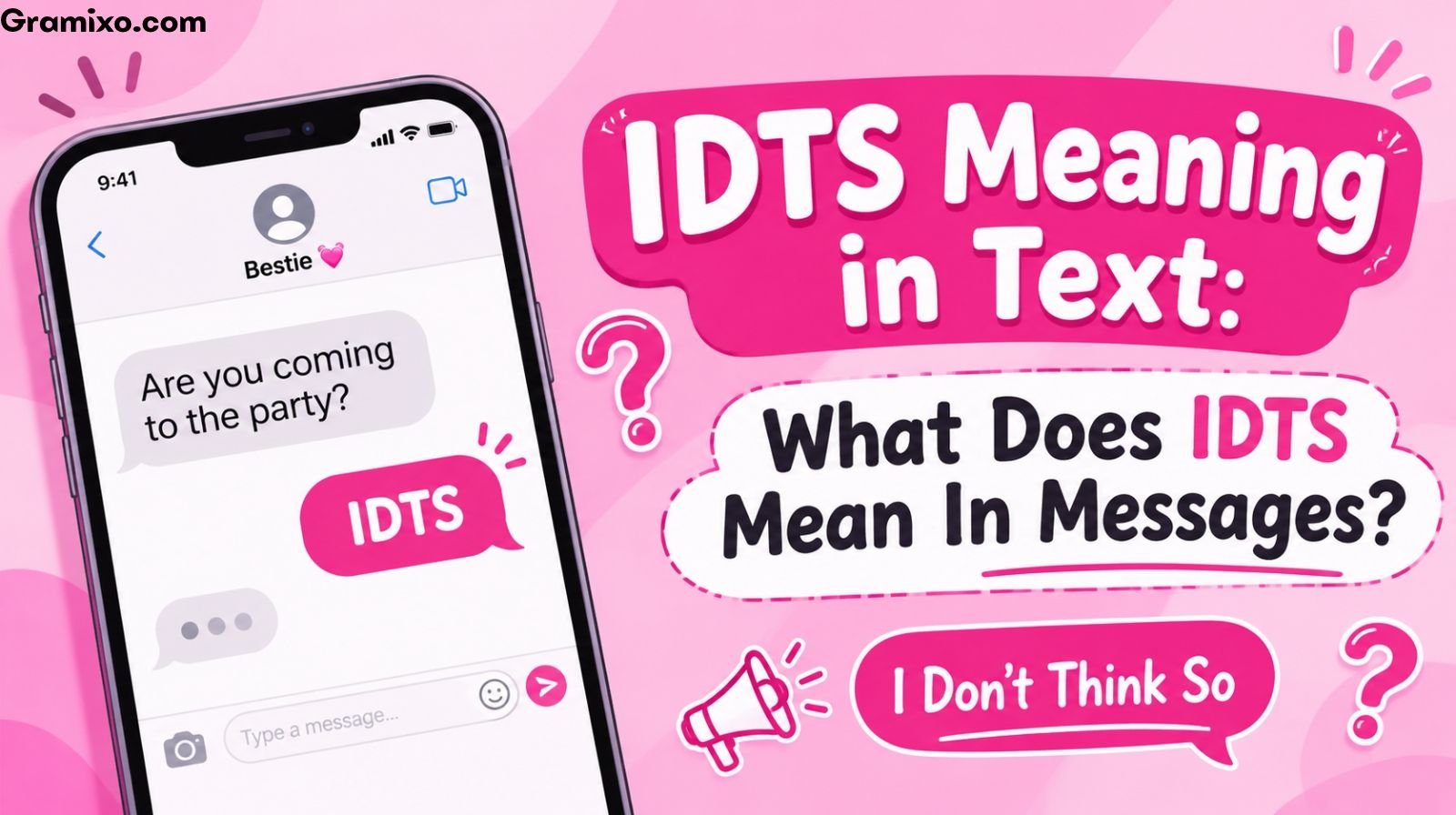
IDTS Meaning in Text: What Does IDTS Mean In Messages? If someone sends you IDTS in a text message, they’re most likely saying “I Don’t Think So.” It’s a short, casual abbreviation people use when they disagree, doubt something, or don’t believe something is likely to happen.
For example:
- Friend: Are you coming to the party tonight?
- You: IDTS, I have too much work to finish.
In this conversation, IDTS means the person probably won’t attend the party.
The expression is common in casual digital conversations because it communicates a quick opinion without requiring a longer explanation. However, its tone can change depending on the situation. It may sound friendly, uncertain, doubtful, or slightly dismissive.
Let’s look at how IDTS works in everyday texting, what it means in different situations, and how you can respond naturally.
What Does IDTS Stand For?
IDTS stands for “I Don’t Think So.” Each letter represents the beginning of one word:
- I – I
- D – Don’t
- T – Think
- S – So
It’s an initialism formed from the full phrase. People type it instead of writing the entire sentence, especially when replying quickly.
For example:
Friend: Do you think we’ll finish the project today?
You: IDTS. We still have three tasks left.
Here, the sender doesn’t believe the project will be completed that day.
You may see IDTS written in different ways, including:
- IDTS
- idts
- Idts
All three generally carry the same meaning. Capitalization doesn’t change the expression.
How Is IDTS Used in Text Messages?
IDTS is useful when someone wants to express an opinion, disagree with an idea, or give a doubtful answer without typing a long response.
Its meaning usually falls into a few everyday situations.
1. Expressing Doubt
Someone may use IDTS when they aren’t convinced something will happen.
Example:
Friend: Do you think our teacher will cancel tomorrow’s class?
You: IDTS, she hasn’t mentioned anything.
The sender doubts that the class will be canceled.
2. Politely Disagreeing
IDTS can help someone disagree without making the conversation unnecessarily argumentative.
Example:
Friend: This is definitely the best restaurant in town.
You: IDTS, the place we visited last week was better.
Here, the sender shares a different opinion.
3. Giving a Negative Answer
Sometimes IDTS works as a softer way to say probably not.
Example:
Friend: Are you joining us for the movie tonight?
You: IDTS, I’m feeling pretty tired.
It communicates that the person probably won’t join.
4. Showing Disbelief
People also use IDTS when they find a statement difficult to believe.
Example:
Friend: He says he finished the entire assignment in ten minutes.
You: IDTS 😂
The response suggests that the sender doesn’t believe the claim, possibly in a joking way.
What Does IDTS Mean on Social Media?
On social media, IDTS carries the same meaning as it does in private messages: I Don’t Think So. It doesn’t have a separate definition on different platforms.
You might encounter it in:
- Instagram: Someone may use IDTS when disagreeing with an opinion in a comment or direct message.
- Snapchat: Friends can use it to answer questions about plans, activities, or personal opinions.
- TikTok: It can appear in comments when someone doubts a prediction or disagrees with a video.
- WhatsApp: People may use it in individual chats and group conversations to give quick answers.
- Discord: It can appear in gaming chats or community discussions when someone questions an idea.
For example, someone might comment:
“IDTS, this trend is going to last that long 😂”
The person is expressing doubt about how long the trend will remain popular.
The important thing is that the meaning stays consistent. The surrounding conversation helps you understand whether the person is joking, disagreeing, or simply giving an honest opinion.
Real Examples of IDTS in Text Messages
Seeing IDTS in actual conversations makes its meaning easier to understand. Here are 15 original examples showing how people might use it in everyday situations.
1. Talking About Weekend Plans
Friend: Are we going shopping this Saturday?
You: IDTS, I have some family plans.
Meaning: You probably won’t be available.
2. Discussing School
Friend: Do you think the exam will be difficult?
You: IDTS, our teacher said it would be easy.
Meaning: You don’t expect the exam to be difficult.
3. Talking About Weather
Friend: Is it going to rain today?
You: IDTS, the sky looks pretty clear.
Meaning: You don’t think it will rain.
4. Discussing a Movie
Friend: Do you think this movie deserves an award?
You: IDTS, the story wasn’t that interesting.
Meaning: You disagree with the suggestion.
5. Making Future Plans
Friend: Will you be free next weekend?
You: IDTS, but I’ll let you know.
Meaning: You don’t expect to be available, although you’re not completely certain.
6. Talking About Friends
Friend: Do you think Sarah is upset with me?
You: IDTS, she was laughing with you earlier.
Meaning: You don’t believe Sarah is upset.
7. Casual Gaming Conversation
Friend: Think we can win this match?
You: IDTS, their team is too strong 😂
Meaning: You doubt that your team will win.
8. Discussing Food
Friend: Is that restaurant better than the old one?
You: IDTS, the old one has much better food.
Meaning: You don’t agree with the comparison.
9. Talking About Work
Coworker: Do you think we’ll finish everything before Friday?
You: IDTS, there’s still a lot to do.
Meaning: You doubt the work will be completed by Friday.
10. Romantic Conversation
Partner: Do you think we’ll ever stop arguing?
You: IDTS, we just need to understand each other better.
Meaning: You don’t think the disagreements will disappear automatically.
11. Responding to a Rumor
Friend: I heard that our favorite singer is retiring.
You: IDTS, that sounds like a rumor.
Meaning: You don’t believe the information is true.
12. Discussing an Invitation
Friend: Are you coming to my birthday party?
You: IDTS, I might have to travel that day.
Meaning: You’re probably unable to attend.
13. Sharing Opinions Online
Friend: Everyone says this new game is amazing.
You: IDTS, I’ve seen better games.
Meaning: You don’t share the same opinion.
14. Talking About Shopping
Friend: Do you think these shoes are worth the price?
You: IDTS, they’re way too expensive.
Meaning: You don’t think the shoes offer good value.
15. A Playful Conversation
Friend: Bet you can’t beat me in this game.
You: IDTS, you’re the one who’s going to lose 😂
Meaning: You’re playfully challenging your friend and expressing confidence.
What Tone Does IDTS Communicate?
Although the basic definition stays the same, IDTS doesn’t always sound identical. The conversation, punctuation, and emojis can influence how someone interprets it.
Here are four common tones:
| Tone | Example | What it communicates |
|---|---|---|
| Neutral | IDTS, it’s too late. | A simple doubtful opinion |
| Friendly | idts haha | A relaxed disagreement |
| Sarcastic | IDTS 😂 | Playful disbelief |
| Firm | IDTS. | A direct negative opinion |
A short IDTS response isn’t automatically rude. Some people simply prefer brief messages.
However, if someone uses it during a serious conversation without explaining their opinion, it might feel dismissive. Reading the surrounding messages is the best way to understand their intention.
Is IDTS Formal or Informal?
IDTS is an informal texting abbreviation, not a formal English expression. It’s suitable for relaxed conversations where both people understand internet shorthand.
You can comfortably use it with:
- Friends and classmates.
- Family members who understand texting abbreviations.
- People you regularly chat with.
- Online communities and gaming friends.
- Casual social media conversations.
However, it’s better to avoid IDTS in professional emails, business reports, academic assignments, and formal communication.
Instead of writing:
“IDTS we can complete the project today.”
You could write:
“I don’t think we can complete the project today.”
The complete sentence sounds clearer and more professional, especially when communicating with someone who may not recognize texting abbreviations.
How Do You Reply to IDTS in a Conversation?
If someone sends you IDTS, your response depends on what they’re discussing. You don’t need to treat it as a complicated expression.
Here are some natural replies.
1. When You Want to Understand Their Opinion
- “Why do you think so?”
- “What’s making you say that?”
- “Can you explain?”
2. When You Agree With Them
- “Yeah, you’re probably right.”
- “I was thinking the same thing.”
- “Fair enough!”
3. When You Disagree
- “I actually think it might happen.”
- “Maybe, but I’m not so sure.”
- “Let’s see what happens.”
4. When They’re Declining an Invitation
- “No worries!”
- “That’s completely fine.”
- “Maybe another time.”
5. When They’re Being Playful
- “Haha, we’ll see!”
- “Don’t be so sure 😂”
- “I guess we’ll find out!”
The best response is one that fits the subject of the conversation. If the message is unclear, simply asking what they mean is perfectly fine.
IDTS vs. Similar Texting Abbreviations
IDTS is sometimes confused with other short expressions because they all appear in casual messages. However, each abbreviation communicates something different.
| Abbreviation | Full Meaning | Main Use |
|---|---|---|
| IDTS | I Don’t Think So | Expressing doubt |
| IDK | I Don’t Know | Showing uncertainty |
| IDT | I Don’t Think | Sharing an incomplete or continuing thought |
| IDC | I Don’t Care | Showing a lack of concern |
| IMO | In My Opinion | Sharing a personal viewpoint |
| TBH | To Be Honest | Expressing an honest opinion |
| NGL | Not Gonna Lie | Introducing a frank statement |
The most important difference is between IDTS and IDK.
- IDTS: You have an opinion, but you think the answer is probably no.
- IDK: You don’t have enough information to give an answer.
For example:
Question: Do you think Alex will come?
Answer 1: IDK. (You don’t know whether Alex will come.)
Answer 2: IDTS. (You don’t think Alex will come.)
Understanding this difference helps you interpret messages more accurately.
Can IDTS Have Different Meanings?
In ordinary texting and internet slang, IDTS overwhelmingly means I Don’t Think So.
Its interpretation can change slightly depending on the conversation, but that doesn’t mean every tone represents a completely different abbreviation.
For example:
- Uncertainty: “IDTS, I’m not sure about the schedule.” The sender isn’t confident.
- Disagreement: “IDTS, I prefer the other option.” The sender has a different opinion.
- Negative response: “IDTS, I can’t make it.” The sender probably won’t attend.
- Disbelief: “IDTS 😂” The sender finds something difficult to believe.
You may occasionally see unusual interpretations on informal slang websites or in private conversations. However, there’s no strong reason to treat those as equally established meanings.
If you’re unsure what someone intends, consider the previous messages rather than assuming IDTS has an entirely different definition.
Common Mistakes to Avoid When Using IDTS
Even though IDTS is simple, a few small mistakes can create confusion.
1. Using it when you mean IDK
IDK means you don’t know something, while IDTS communicates that you don’t think something is true or likely.
2. Using it in serious professional communication
A complete sentence is more appropriate when discussing important work matters.
3. Sending it without context
A standalone IDTS can sometimes leave the other person wondering what you’re disagreeing with.
4. Using it when you need a definite answer
IDTS often expresses an opinion rather than confirmed information. If you know something definitely won’t happen, a clear explanation may be better.
5. Assuming it’s always rude
IDTS isn’t automatically disrespectful. It can be a normal, friendly way to express disagreement.
Frequently Asked Questions
Here are some common questions people ask when they encounter this abbreviation in messages.
1. What does IDTS mean in text messages?
IDTS means “I Don’t Think So.” It’s commonly used to express doubt, disagreement, or a negative response in casual conversations.
2. What does IDTS stand for?
IDTS stands for I Don’t Think So. Each letter represents one word from the original phrase.
3. Is IDTS slang?
Yes. IDTS is informal internet and texting shorthand. People use it in messages, online chats, comments, and direct messages.
4. Is IDTS the same as no?
Not exactly. IDTS usually means “probably not” or “I don’t believe so.” A simple no can communicate a more definite answer.
5. Is IDTS rude?
No, not automatically. It generally expresses doubt or disagreement. However, a short response without an explanation may sound blunt in certain situations.
6. What does IDTS mean from a girl?
It has the same meaning regardless of who sends it. A girl using IDTS is generally saying “I Don’t Think So.” Her tone depends on the conversation.
7. What does IDTS mean from a guy?
It also means “I Don’t Think So.” It doesn’t automatically indicate romantic interest, anger, or any particular emotion.
8. Can I use IDTS on Instagram and Snapchat?
Yes. You can use it in Instagram DMs, Snapchat messages, and other casual online conversations. Its meaning generally stays the same.
9. What is the difference between IDTS and IDK?
IDTS means “I Don’t Think So,” while IDK means “I Don’t Know.” The first expresses doubt or a negative opinion; the second communicates a lack of knowledge.
10. How do I respond when someone says IDTS?
You can respond with “Why do you think so?”, “Fair enough,” or “Maybe you’re right.” Choose a reply that fits the conversation.
11. Should I use IDTS in professional emails?
It’s better to avoid it. Write “I don’t think so” or “I don’t believe that will work” to keep your message professional and clear.
12. Does capitalization change the meaning of IDTS?
No. IDTS, Idts, and idts generally communicate the same phrase. The difference is simply the writer’s typing style.
13. Can IDTS be used sarcastically?
Yes. Someone can use IDTS sarcastically to express disbelief or playfully challenge another person’s statement. Emojis and surrounding messages can make the intention clearer.
14. Is IDTS a positive or negative expression?
It’s generally a negative or doubtful response because it communicates that someone doesn’t think something is true or likely. However, it isn’t necessarily unfriendly.
15. Is IDTS commonly used in everyday conversations?
It’s recognized in informal texting and online communication, although individual usage varies. Some people prefer typing the complete phrase instead.
Conclusion
IDTS means “I Don’t Think So” in text messages and online conversations. It’s a simple abbreviation people use to express doubt, disagree with an opinion, show disbelief, or give a softer negative response.
You may see it in WhatsApp messages, Instagram DMs, Snapchat conversations, TikTok comments, and other casual online chats. Although its tone can change depending on the situation, its basic meaning generally stays the same.
Remember the difference between IDTS and IDK: IDTS means you don’t think something is likely, while IDK means you don’t know the answer. Once you understand that distinction, recognizing and using IDTS becomes much easier.
Discover More Article
- Restaurant Guru Meaning: Definition, Context, Examples, And Modern Usage (2026 Guide)
- WBU Meaning in Text: The Easy Chat Shortcut To Know
- Strunk Meaning Slang: Is It Slang Or A Typo?
- IKTR Meaning in Text Messages: Examples & Context
- TM Meaning in Text: What It Really Means And How To Use It
- W Meaning in Text: What It Really Means In Chats & Social Media
- RD Meaning in Text: Full Form, Chat Use & Examples
- FYP Meaning in Text: The Feed, The Degree, And The Fix
Keep learning with more easy grammar lessons on: Gramixo.com

Hi, I’m Bilal Khalid, the founder of Gramixo. I’m passionate about helping people improve their English through clear, practical, and easy-to-follow grammar content. By combining my experience in SEO with a focus on creating helpful educational resources, I publish guides that simplify Grammar rules, explain common mistakes, and improve writing skills. Whether you’re a student, a professional, or an English learner, my goal is to make learning grammar easier, more enjoyable, and genuinely useful in everyday life.