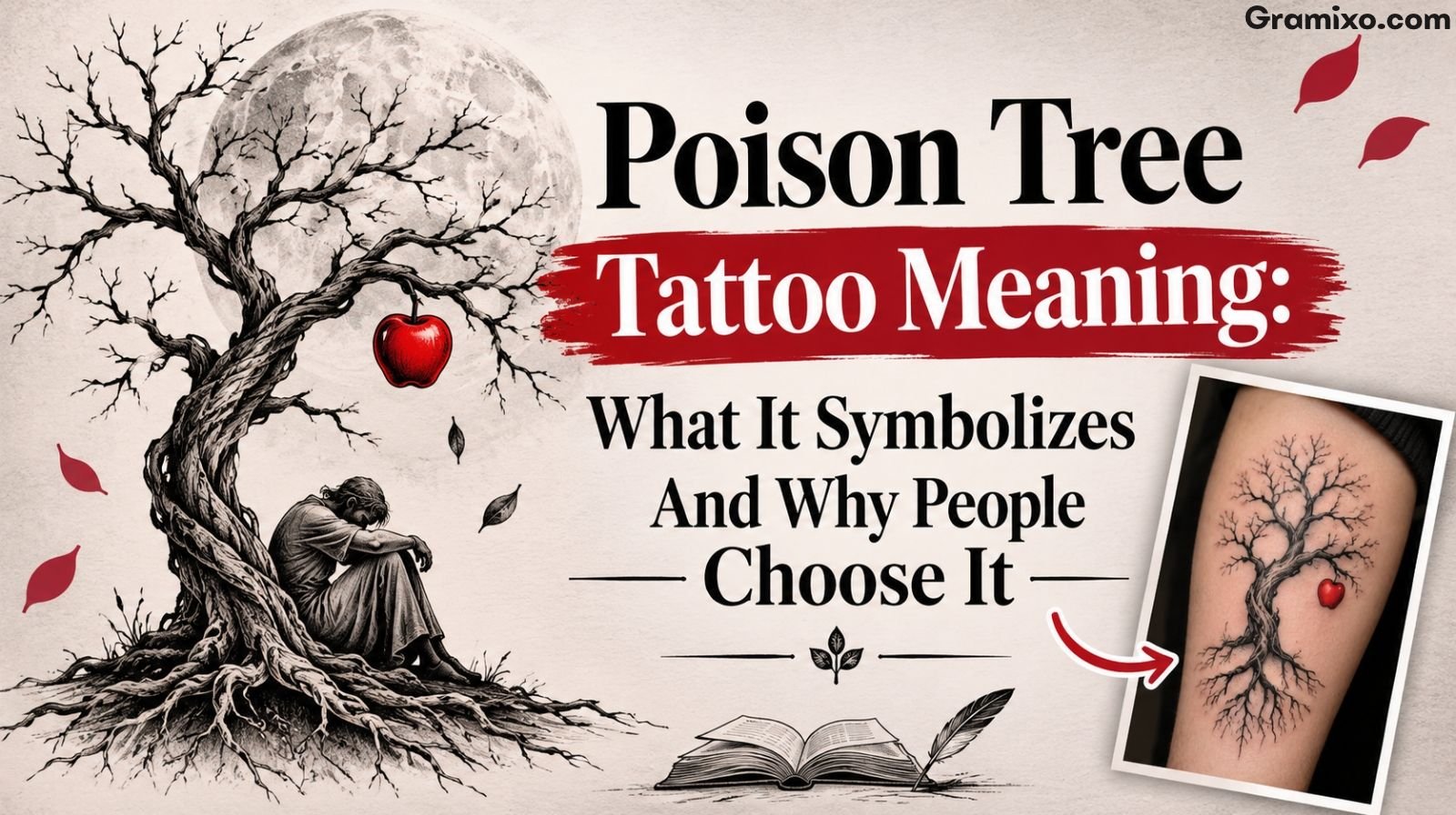
A poison tree tattoo usually stands for anger that was never spoken and slowly grew into something harmful. The image comes from William Blake’s 1794 poem “A Poison Tree,” in which a man hides his rage at an enemy until it becomes a tree that bears deadly fruit.
People who get this tattoo rarely mean it as a celebration of revenge. More often it’s a reminder of what happens when resentment goes unspoken, a marker of something the wearer has worked through, or a tribute to a poem they love. There’s no official meaning, so what it says depends on the person wearing it.
This guide covers where the design comes from, what the poem says, the main interpretations, the design details worth knowing, and what to think about before you commit to the ink.
What Does a Poison Tree Tattoo Mean?
The short answer is repressed anger and its consequences. Almost every serious source on the design points back to Blake and his warning about bottling up wrath.
The longer answer is that the tattoo works on two levels. On the surface, it’s a striking botanical image: a bare, twisted tree, usually with an apple hanging from a branch. Underneath, it’s a story about honesty, resentment, and the cost of hiding what you feel.
Because the story is so short and so open to interpretation, wearers bring their own experiences to it. A person recovering from a bitter family conflict might read it differently from someone who simply loves Romantic poetry. Both readings are valid.
The Poem Behind the Tattoo
The poison tree isn’t an ancient symbol with a long tattoo tradition. It’s literary, and its source is easy to pin down. Blake published “A Poison Tree” in 1794 as part of Songs of Experience, the darker companion to his earlier Songs of Innocence. The poem is only sixteen lines long, written in a sing-song rhythm that makes its grim content feel stranger.
Here’s what happens, stanza by stanza:
- The friend and the foe. The speaker gets angry with a friend, says so, and the anger is gone. Then he gets angry with an enemy, says nothing, and the anger grows.
- The tending. He feeds that anger the way a gardener would. He waters it with fear and tears, and he “suns” it with smiles and deceit, hiding his real feelings behind a friendly face.
- The fruit. The anger grows day and night until it produces a bright apple. The enemy sees it shine and knows it belongs to the speaker.
- The ending. The enemy sneaks into the garden at night and eats the apple. In the morning, the speaker is glad to find him lying dead beneath the tree.
One detail surprises many readers: the tree is never mentioned in the poem itself, only in the title. Blake lets the reader build the metaphor, which helps explain why the image has stuck so well.
Another detail is the poem’s earlier title. In Blake’s notebook draft, it was called “Christian Forbearance.”
That title suggests Blake was questioning whether holding anger in, something religious teaching often praises as patience or self-control, is really a virtue. In the poem, restraint doesn’t produce peace. It produces poison.
The poem wasn’t a hit in Blake’s own lifetime. According to the standard reference accounts, it first appeared on its own in 1830, in the London University Magazine, and it has since become one of his most studied works. It’s been set to music by composers including Ralph Vaughan Williams and Benjamin Britten.
The Symbols Inside the Poem and What They Add to a Tattoo
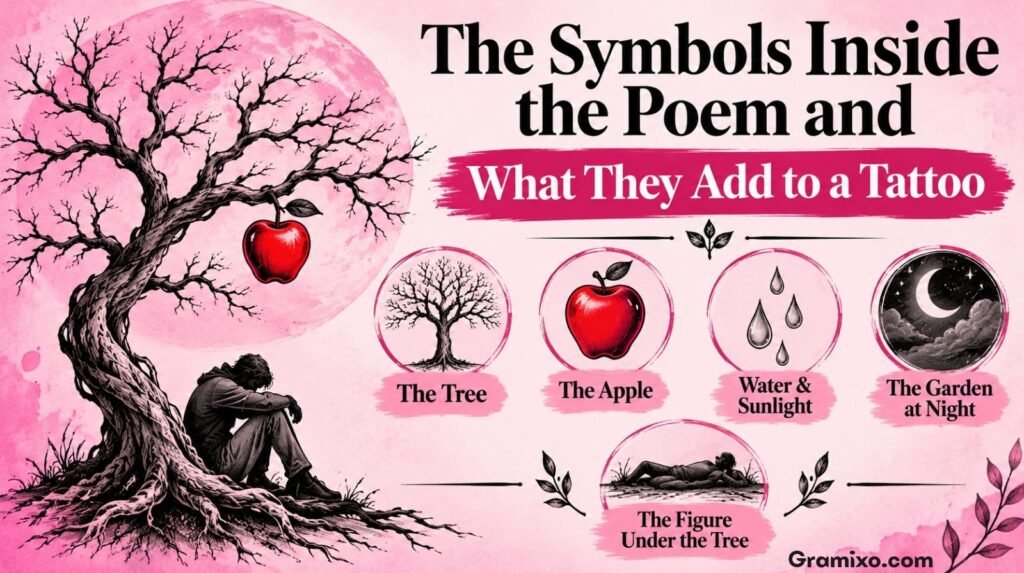
Every part of the poem can be carried into a design. Knowing what each one stands for helps you decide what to include.
The tree
The tree is the anger itself, taken full-grown. A bare or twisted tree is the easiest way to show it, and it also echoes Blake’s own printed plate, which shows a leafless tree.
The apple
The apple is the fruit of the speaker’s hidden wrath, and it’s the bait that draws his enemy in. Because an apple also recalls the Garden of Eden, many readers connect it to temptation and corruption. In a tattoo, a single bright apple is often the focal point.
Water and sunlight
The speaker “waters” his anger with tears and “suns” it with smiles. This is the most psychologically sharp part of the poem. The anger isn’t just left alone. It’s fed, and the smiles that feed it are fake. Some designs hint at this with falling droplets or rays of light, though it’s subtle.
The garden at night
The enemy comes in secret, under cover of darkness. Moons, stars, and shadowy backgrounds nod to this, and they also give the piece a gothic mood.
The figure under the tree
The ending of the poem is a body lying beneath the branches. Blake’s own illustration for the plate shows exactly that: a prone figure under a bare tree. Including a figure is the most literal way to reference the poem, but it’s also the darkest, so some wearers leave it out.
What the Tattoo Can Mean for the Wearer
Here are the most common personal readings.
Suppressed anger. This is the central meaning. The tattoo says that anger you swallow doesn’t vanish. It can grow quietly until it does real damage.
A lesson learned. Some people get the tattoo after realizing they’d held a grudge for years. For them, it’s a promise to speak up sooner and to have the hard conversation instead of rehearsing it in their head.
Betrayal and resentment. For others, the tree represents a painful relationship and the bitterness that followed it. The tattoo can mark an experience that changed them.
Healing and letting go. The tattoo doesn’t have to stay dark. Some wearers treat it as a record of what they carried, and a sign they’ve put it down. The poem shows how poison grows, and a person who recognizes it can choose to stop watering it.
Deceit and hidden motives. The speaker’s smiles and soft deceit make the poem a study in hypocrisy. Some people choose the tattoo to represent masks, secrets, or the gap between how someone looks and what they feel.
Love of Blake. Plenty of people just love the poem, or Blake’s art, and want a piece of it on their skin. That’s a perfectly good reason, and it doesn’t need a deeper story.
Is a Poison Tree Tattoo Dark or Negative?
It can look that way, but it isn’t necessarily negative. The poem ends in death, so the imagery is serious. Still, the tattoo isn’t a statement that you want to harm anyone.
Even among people who study the poem, readings differ. Some see it as a straightforward warning about anger. Others see it as a criticism of a moral system that praises restraint while producing resentment.
Some scholars note that the speaker has a Satan-like quality, and a few readers see him as a divine figure who tempts humanity into a fall. Those are interpretations, not settled facts, and they show how much room the poem leaves.
That openness is part of the tattoo’s appeal. You can make it as dark or as hopeful as you like through the details you choose.
Common Design Ideas
Most poison tree tattoos draw from a short list of elements:
- A bare, twisted tree with exposed roots or gnarled branches
- A single apple hanging low or fallen on the ground
- A figure lying beneath the tree, referencing the poem’s ending
- Lines from the poem, often the opening couplet about telling or hiding wrath
- Gothic extras like crows, a full moon, or thorns for a darker look
- Engraving-style linework that mimics Blake’s own printmaking
If you want something gentler, you could keep the tree and apple but leave out the figure, add a few small leaves, or let the roots reach into open space. The same story reads very differently with a few small changes.
Styles and Placement
Fine-line and minimalist designs work well for small pieces, like a single branch with one apple. They suit wrists, ankles, behind the ear, or along the collarbone.
Blackwork and dotwork give a heavier, more dramatic look. They suit larger spaces like the forearm, calf, or upper arm.
Engraving-inspired styles borrow from Blake’s etching and printmaking. They’re a natural fit for a literary tattoo and can look timeless.
Illustrative or realistic styles allow more detail, such as a full scene with the garden and the figure, and they suit the back, ribs, or thigh.
On pain, it depends mostly on placement. Areas with thin skin over bone, like the ribs and spine, tend to be more sensitive, while meatier areas like the outer thigh or upper arm are usually easier. Your artist can talk you through what to expect.
How to Explain It When People Ask
Because the tattoo isn’t instantly recognizable to everyone, you’ll probably get questions. Here’s how those conversations tend to go:
Coworker: That’s a cool tree. Is there a story behind it?
You: It’s from a Blake poem about anger you never talk about. I got it after I finally had a conversation I’d been avoiding for years.
Friend: Wait, is that a revenge tattoo?
You: Kind of the opposite. It’s a warning about what happens when you don’t say what’s bothering you.
Classmate: Is that from a book?
You: A poem, actually. “A Poison Tree” by William Blake. It’s short, you could read it in a minute.
There’s no right answer. Some people prefer a short, private explanation, and others keep it vague. Decide beforehand how much you want to share.
What to Think About Before Getting One
Know what it means to you. A clear reason helps your artist shape the design, and it helps you explain it later. If your reason is still vague, give it time.
Expect different reactions. Some people will read the tattoo as dark or vengeful without knowing the poem. If you want a gentler message, tell your artist, and consider details that soften it.
Check any text carefully. Spelling and punctuation vary between editions of Blake’s poems. Choose one version and have your artist copy it exactly, since a typo in a permanent tattoo is hard to undo.
Think about the personal connection. If the tattoo is tied to a painful relationship, ask yourself how you’ll feel about it in ten years. Many people find it still carries meaning, but it’s worth considering.
Find an artist who fits the style. Fine-line, blackwork, and engraving styles are different specialties. Look through portfolios before booking.
Don’t confuse it with the legal phrase. “Fruit of the poisonous tree” is a legal doctrine and has nothing to do with Blake’s poem or this tattoo.
Similar Tattoos and Symbols
If the poison tree isn’t quite what you’re after, a few related ideas carry overlapping themes:
- Apple tattoos focus on temptation, knowledge, or the Garden of Eden without the full story of the poem.
- Other Blake-inspired tattoos, such as lines or imagery from his other work, suit people who love the poet more than this one poem.
- A tree of life points toward growth and connection, which is nearly the opposite of the poison tree’s tone.
- Thorn or briar designs can suggest hurt and protection without a specific literary source.
The difference is mostly one of story. A poison tree tattoo tells one particular tale. Most of these alternatives are more general.
Myths and Unsupported Claims
If you search for this tattoo, you’ll run into a lot of repetitive pages with big claims. A few are worth treating carefully.
- “Ancient folklore.” Some pages describe long-standing cultural traditions around poison trees as a tattoo symbol. I couldn’t find reliable support for this. The tattoo’s roots are Blake.
- “Poison trees thrive in harsh places, so it means surviving trauma.” This is an interpretation some people add, not part of the poem. It’s fine as a personal meaning, but it isn’t the source meaning.
- Invented experts. Several pages quote named “experts” I couldn’t trace to any real source. Treat unattributed quotes with caution.
The core meaning is well established, and the personal layers are up to you.
Frequently Asked Questions
What does a poison tree tattoo mean?
It generally represents suppressed anger and its destructive growth, based on William Blake’s poem “A Poison Tree.” Many people also use it to express healing, betrayal, or lessons about honesty.
Is a poison tree tattoo based on a poem?
Yes. The imagery comes from Blake’s 1794 poem, published in Songs of Experience.
Is it a negative tattoo?
Not necessarily. The poem is dark, but many wearers treat the tattoo as a sign of growth, self-awareness, or recovery.
What does the apple represent?
In the poem, the apple is the fruit of the speaker’s hidden anger and the lure that draws his enemy in. Some readers also connect it to the biblical apple and temptation.
Can I get just a tree without any text?
Yes, and many people do. A bare tree, an apple, or a figure beneath the branches can all point to the poem without quoting it.
Does it mean revenge?
Usually not. The poem shows how hidden anger leads to harm, so most wearers see the tattoo as a warning or a reflection, not a call for payback.
Where is the best place to get it?
That depends on size and style. Larger, detailed designs suit the forearm, back, or thigh, while small minimalist versions suit the wrist or behind the ear.
Final Thoughts
The poison tree tattoo means what Blake’s poem means: anger that’s hidden instead of spoken can grow into something dangerous. How you read that is up to you. For some people it’s a warning, for some it’s proof they’ve healed, and for some it’s a favorite poem on their skin.
Whichever it is, it helps to know the story behind it. Read the poem once, decide what it means to you, and bring that clarity to your artist.
Discover More Article
- JSP Meaning in Text: What It Means And When It Backfires
- What Does MYM Mean in Text? Emotional And Cultural Insights
- RQ Meaning in Text: “Real Quick” In Chat, “Rage Quit” In The Game
- FYP Meaning in Text: The Feed, The Degree, And The Fix
- IDTS Meaning in Text: What Does IDTS Mean In Messages?
- Cum Meaning: What Does Cum Mean In Text, Slang, And English?
- OAT Meaning in Text: What It Really Means, How To Use It?
Keep learning with more easy grammar lessons on:
Gramixo.com
Hi, I’m Bilal Khalid, the founder of Gramixo. I’m passionate about helping people improve their English through clear, practical, and easy-to-follow grammar content. By combining my experience in SEO with a focus on creating helpful educational resources, I publish guides that simplify Grammar rules, explain common mistakes, and improve writing skills. Whether you’re a student, a professional, or an English learner, my goal is to make learning grammar easier, more enjoyable, and genuinely useful in everyday life.