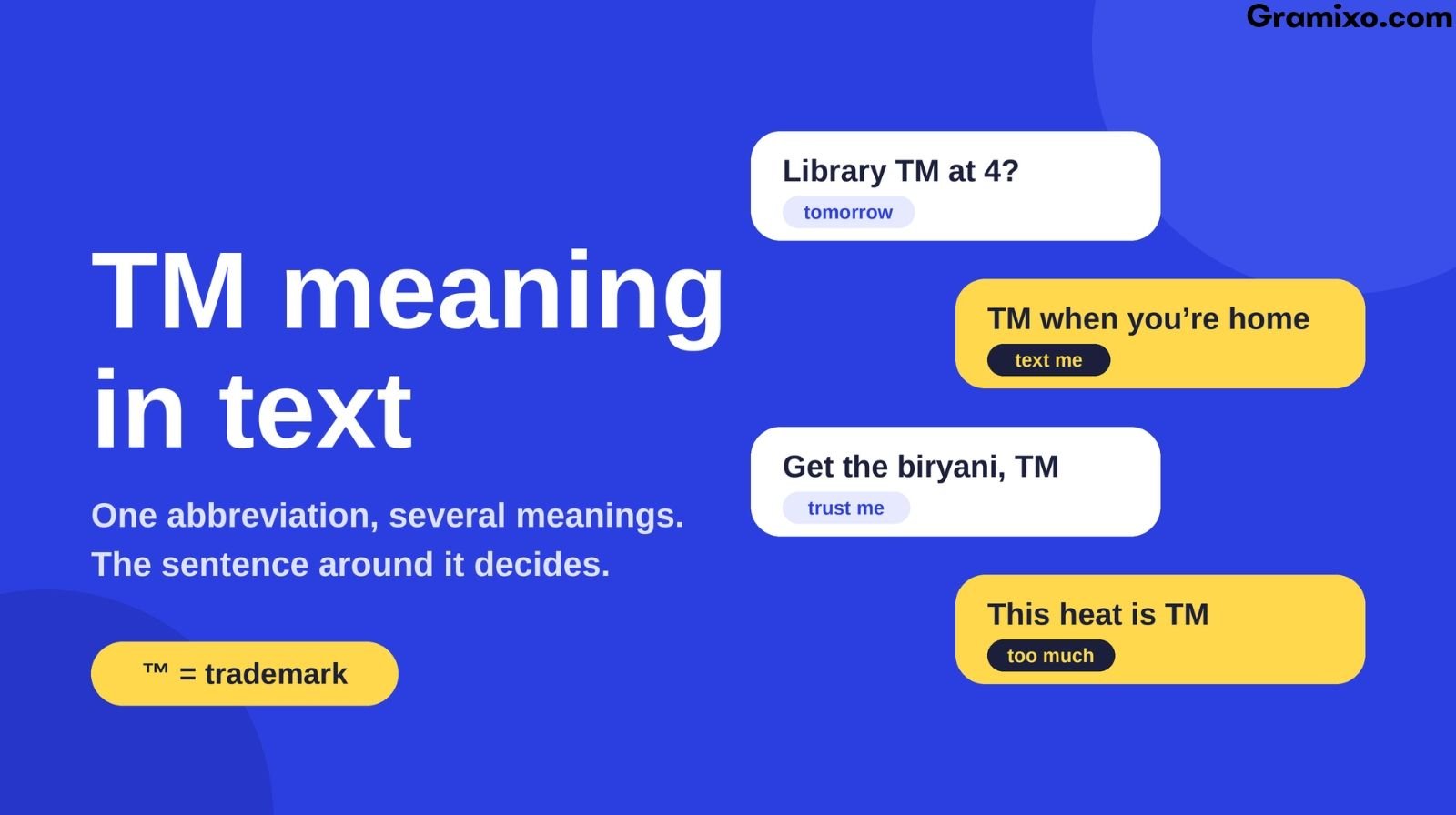
If someone sent you a message with “TM” in it, here’s the short answer. TM in text usually means “tomorrow,” “text me,” “trust me,” or “too much,” depending on the sentence. Outside of texting, TM (or ™) stands for trademark.
Slang is messy, and TM is a good example. It has no official definition, no single origin, and no fixed meaning.
People type it quickly and rely on the other person to work it out. That’s why one friend can send “TM” and mean tomorrow while another uses it to mean “text me.”
This article covers each meaning, how to tell them apart, what to say back, and when to avoid TM altogether.
What Does TM Mean in Text Messages?
Here are the meanings you’re most likely to run into, with a note on how each one usually shows up.
TM = Tomorrow
This is a simple time-saver. Someone shortens “tomorrow” to “tm” because they’re typing fast or want to keep the message short. You’ll almost always see it next to a time, a day, or a plan.
- “Are we meeting tm?”
- “Can’t do today, free tm after 5.”
The more common spelling is “tmrw” or “tmr,” but “tm” still appears, especially in quick one-line texts.
TM = Text Me
Here TM is a request. The sender wants you to message them instead of calling, or wants a heads-up when something happens.
- “TM when you reach home.”
- “Busy right now, TM your address.”
It’s usually at the beginning or end of the message and often comes with a “when” or “once.”
TM = Trust Me
This one adds emphasis or reassurance. The sender is trying to convince you, and it often sounds confident or a little playful.
- “It’s not as hard as it looks, TM.”
- “Order the fries, TM.”
TM = Too Much
People use this as a reaction when something is overwhelming, impressive, funny, or ridiculous. It’s more common in captions, comments, and casual replies than in plans or instructions.
- “This heat is TM.”
- “Her outfit is TM 😍”
It can be positive (“so good it’s too much”) or negative (“I can’t handle this”). The emoji and tone usually show which.
TM = Trademark (the joke version)
Some people write TM or ™ after a phrase to claim it as their own. It’s a joke, a way of saying “I invented this” or “this is my signature thing.”
- “Showing up five minutes before it starts™”
- “My nap schedule is a lifestyle, TM.”
Less common meanings
You may see “tell me” or “talk to me” in some places, and a few sites list other options. These show up rarely, and I’d only guess them if none of the main meanings fit.
Be skeptical of any list claiming a dozen or more TM meanings in texting, because many of those are padding rather than real usage.
Which Meaning of TM Is the Most Common?
There’s no honest way to name a single winner. When I compared several pages that rank for this term, they disagreed.
Some treat “text me” as the main meaning, others lead with “trust me,” others with “tomorrow,” and a few with “trademark.” None of them cite real usage data, so any ranking would be a guess.
What you can say is that the answer depends on where you see it:
- In planning chats, tomorrow is a safe first guess.
- In requests, think text me.
- In captions, comments, and reactions, think too much.
- On products, logos, and brand names, it’s trademark.
So don’t memorize a “top meaning.” Learn the clues, and you’ll get it right most of the time.
How to Tell Which TM Someone Means
A few quick checks will settle most messages.
1. Look for a time word. If the message mentions a time, a day, or a plan (“lunch at 1 tm”), it’s tomorrow.
2. Check whether it’s a request. If the sender seems to want you to do something (“TM when you’re free”), it’s text me.
3. See whether it backs up a claim. If TM follows a promise, a recommendation, or reassurance, it’s trust me.
4. Look at the emotion. If it follows a complaint, a compliment, or an exaggeration (“this assignment is TM”), it’s too much.
5. Look for a brand or catchphrase. If it’s glued to a name or phrase, it’s trademark, either literally or as a joke.
6. Think about who sent it. A friend who types in shorthand all day is likely using slang. A manager using “TM” in a workplace chat may mean “team member.”
Some messages fit two meanings. “Call me TM” could be “call me tomorrow” or “call me, trust me.” When it matters, ask.
TM on Social Media and Messaging Apps
The meaning doesn’t change much between apps, since it’s the same slang everywhere. What changes is how likely each meaning is, and that depends on how people use the platform.
WhatsApp and SMS lean toward practical messages, so tomorrow and text me are the most natural reads. Family chats and friend groups use it to plan things.
Snapchat is quick and informal. TM could be tomorrow, text me, or trust me. If the snap has a caption about a plan, tomorrow is likely.
Instagram DMs and comments often lean toward reactions, so too much is more likely there, especially under photos or reels. In captions, you may also see the joke trademark.
TikTok comments are similar. Short reactions like “TM” appear under videos, and the joke trademark shows up in captions and bios.
Discord and gaming chats use plenty of abbreviations, but “tmrw” or “tomorrow” is the more common shorthand for scheduling. If someone writes TM there, check the context before assuming.
None of this is a hard rule. If you’re ever unsure, the surrounding message is a better guide than the platform.
Examples of TM in Real Conversations
Friends planning (tomorrow)
Hira: Can we move the call to tm morning?
Usman: Yeah, 10 works.
Hira: Perfect, I’ll send the link tonight.
Family check-in (text me)
Dad: I’m leaving the office now.
You: Okay, TM when you’re close to the gate so I can open it.
Giving advice (trust me)
Areeba: Should I take the early bus?
Noor: Yes, TM. The later one is always packed.
Reacting to a photo (too much)
Fahad: Check out my cousin’s wedding hall.
Sana: The lights are TM, it looks unreal.
School chat (tomorrow, with a twist)
Ali: Do we have the quiz tm?
Bilal: TM as in tomorrow, yes, chapters 4 to 6.
Ali: Ugh, that’s TM for one night 😭
Notice that Ali uses TM twice, first as tomorrow, then as too much. That’s the kind of overlap that makes TM confusing.
Work chat (team member)
Manager: Please share the schedule with each TM by Friday.
You: Sure, I’ll send it to the whole team.
The joke trademark
Friend: You said you’d be ready at 7.
You: I’m always “five minutes away”™.
How to Reply to TM
Pick the reply that matches the meaning.
If TM means tomorrow:
- “Sounds good.”
- “Works for me. What time?”
- “Tomorrow’s tricky, can we do the day after?”
If TM means text me:
- “Will do.”
- “Sure, I’ll message you in a bit.”
- “Can I call instead? Easier for me.”
If TM means trust me:
- “Okay, I’ll go with your pick.”
- “If this goes wrong, I’m blaming you 😄”
- “Convince me first.”
If TM means too much:
- “Right? I can’t handle it.”
- “Haha, so true.”
- “Okay, wait, what happened?”
If you aren’t sure:
- “Do you mean tomorrow or text me?”
- “TM as in too much? 😂”
The last two are perfectly normal. People ask this kind of thing all the time, and it beats guessing wrong.
Is TM Formal or Informal?
As a texting abbreviation, TM is informal. It’s fine in chats with friends, family, and classmates. It isn’t suited to professional writing, because it has too many possible readings.
At work or school, write out the full word:
- Instead of “TM,” write “tomorrow.”
- Instead of “TM me,” write “please text me” or “message me.”
- Instead of “TM,” write “I promise” or “I’m confident about this.”
- Instead of “TM,” write “that’s overwhelming” or “that’s a lot.”
The trademark meaning is the exception. It’s formal and legal, and you’ll see ™ on packaging, websites, and brand materials.
Common Mix-Ups With TM
Tomorrow vs. text message. “Send it TM” could mean “send it tomorrow” or “send it by text.” If there’s a time, it’s tomorrow.
Trust me vs. text me. They look almost identical in a hurry. The first adds emphasis, the second asks for contact.
Too much vs. TMI. TMI means “too much information,” which is specifically about oversharing. TM on its own isn’t.
TM vs. TTM. TTM usually means “talk to me,” which is a separate abbreviation.
Sarcasm. “TM” after something obviously doubtful can sound sarcastic. If a friend says “The train will be on time, TM,” they might be teasing.
TM Outside Texting: Trademark and Other Meanings
Because “TM” shows up in search results with so many meanings, here are the non-slang ones worth knowing.
Trademark (™)
A trademark is a word, phrase, symbol, or design that identifies a brand. The ™ symbol means the owner is claiming trademark rights. In the US, you can use ™ with a mark whether or not it’s been registered with the national trademark office.
TM vs. ® vs. ℠
- ™ claims a trademark, usually for goods. It doesn’t need registration.
- ℠ is the same idea for services.
- ® means the mark is officially registered. It’s meant to be used only after registration, and using it on an unregistered mark can cause legal problems. Rules vary by country, so check local guidance if it matters for your business.
To type ™, press Alt + 0153 on a Windows keypad or Option + 2 on a Mac, or use the symbols keyboard on your phone.
Team Member
Many workplaces use “TM” as an internal label for “team member.” You’ll see it in staff schedules, job descriptions, and messages from managers.
Transcendental Meditation
TM is also the standard shorthand for Transcendental Meditation, a meditation practice. It’s unrelated to texting slang, but you may see it in search results.
How to Use TM Without Confusing People
If you’re sending TM yourself, a few habits help.
- Add a clue. “TM at 5” is clearer than “TM.” “TM me when you’re there” tells the reader it’s a request.
- Match your audience. Friends will get it. Teachers, managers, and relatives who don’t text much might not.
- Use full words when it matters. For plans, deadlines, and addresses, spell it out.
- Don’t stack abbreviations. “TM TTYL TM” will lose the reader.
Similar Terms and Abbreviations
- Tmrw / tmr: clearer shorthand for tomorrow.
- DM: direct message, close to “text me” on social apps.
- TMI: too much information, used when someone overshares.
- TTM: usually “talk to me.”
- FR: “for real,” often used to back up a claim the way “trust me” does.
- SM: can mean service mark (℠) in legal contexts, and “social media” in everyday chat.
Where Does TM Come From?
The origin of TM as texting slang isn’t documented. I couldn’t find a reliable source for who started it or when, and I’d be skeptical of sites that give exact dates.
The likely explanation is simple: people shorten words and phrases to type less, and TM happens to fit several common ones. That’s an educated guess, not a fact. The trademark meaning is better established, since the ™ symbol is a standard legal marker.
Frequently Asked Questions
What does TM mean in texting?
Most often tomorrow, text me, trust me, or too much. Context decides.
What does TM stand for?
There’s no single phrase. In slang it stands for one of the meanings above, and in business it stands for trademark. Some workplaces use it for team member.
Is TM slang?
Yes, in texting it’s informal slang. The trademark meaning is a standard legal term.
Does TM mean “text me”?
It can, especially when it opens or closes a request, like “TM when you’re home.” But it can also mean tomorrow, so check the rest of the message.
Does TM mean “tomorrow”?
Yes, often when it appears with a time or plan. “Tmrw” is the more common spelling, but “tm” is used too.
What does TM mean on Snapchat or Instagram?
It’s the same slang. On Snapchat, it’s often tomorrow, text me, or trust me. On Instagram, especially in comments and captions, “too much” is common.
Is TM rude?
No. It’s neutral, and the tone depends on the words around it.
Can I use TM at work?
Avoid it unless your team already uses it, because it can mean several things. Write the full word instead.
How do I reply if I don’t understand TM?
Ask: “TM as in tomorrow or text me?” It’s quick and avoids mix-ups.
What’s the difference between TM and ®?
™ claims a trademark without registration. ® shows that the trademark is officially registered.
Conclusion
TM is one of those abbreviations that means whatever the sentence needs it to mean. Look for a time, a request, a promise, or a reaction, and you’ll usually land on the right one.
If you still can’t tell, ask. And when you’re the one sending it, add a clue or write the full word so nobody has to guess.
Discover More Article
- BTC Meaning in Text: What It Really Means And How To Use It
- JOI Meaning: What It Really Means And How To Use It?
- Strunk Meaning Slang: Is It Slang Or A Typo?
- TMP Meaning in Text: Why People Use It Online Today
- LDAB Meaning Slang: What Does LDAB Mean In Text & TikTok?
- IKTR Meaning in Text Messages: Examples & Context
- TW Meaning in Text: What It Really Means And How To Use It
Keep learning with more easy grammar lessons on: Gramixo.com

Hi, I’m Bilal Khalid, the founder of Gramixo. I’m passionate about helping people improve their English through clear, practical, and easy-to-follow grammar content. By combining my experience in SEO with a focus on creating helpful educational resources, I publish guides that simplify Grammar rules, explain common mistakes, and improve writing skills. Whether you’re a student, a professional, or an English learner, my goal is to make learning grammar easier, more enjoyable, and genuinely useful in everyday life.