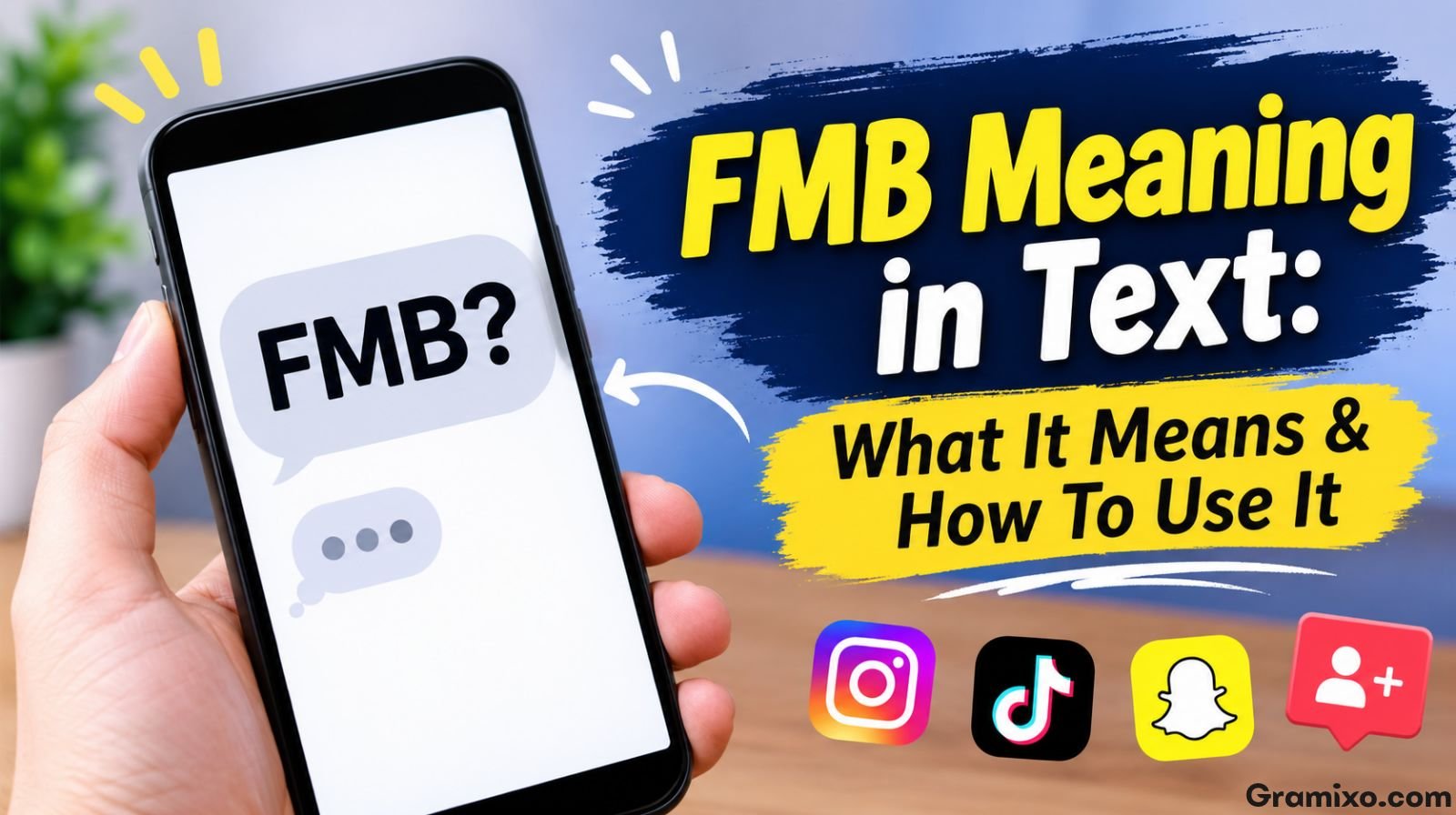
FMB Meaning in Text: What It Means & How To Use It Have you ever received a message containing “FMB” and wondered what those three letters mean? You might see this abbreviation in an Instagram DM, TikTok comment, Snapchat message, or casual online conversation.
FMB usually means “Follow Me Back” in texting and social media. People use it when they want someone to follow their social media account after they have followed that person’s profile.
For example, if someone follows you on Instagram and sends “FMB?”, they’re asking you to follow their account in return.
Although Follow Me Back is the common meaning in social media conversations, FMB can have different interpretations in other contexts. Understanding the conversation helps you identify what someone actually means.
What Does FMB Mean in Text?
FMB stands for Follow Me Back. It’s an informal internet abbreviation used to request a return follow on social media.
Instead of typing the complete phrase, someone can simply write FMB to communicate the same request.
For example:
- “Just followed you, FMB!”
- “Hey, FMB please 😊”
- “New account, can you FMB?”
- “I followed your page. FMB?”
In each example, the sender wants the other person to follow their profile.
FMB is particularly relevant to conversations about social media followers, profile growth, and online connections. It’s a straightforward way to ask for a mutual follow without writing a longer message.
Simple meaning: FMB = Follow Me Back.
What Does FMB Stand For?
FMB is an abbreviation formed from the first letters of the words Follow Me Back.
Here’s how each letter represents part of the phrase:
| Letter | Full Word |
|---|---|
| F | Follow |
| M | Me |
| B | Back |
When combined, these letters create a short expression that asks someone to return a social media follow.
For instance, imagine following someone’s Instagram account. You might send them a quick message saying, “FMB?” rather than typing, “Could you please follow me back?”
The shorter version is convenient for casual conversations, especially when people are communicating through comments or direct messages.
How Is FMB Used in Texting?
FMB is generally used when people discuss following accounts, gaining followers, or connecting with other users online.
It’s not an abbreviation that naturally fits every conversation. Its meaning makes the most sense when the discussion involves social media profiles.
Here are some common situations where someone might use it.
Asking Someone to Follow Back
This is the most straightforward use of FMB. Someone follows your profile and asks you to return the favor.
Example:
Friend 1: Just followed your new account.
Friend 2: Thanks! FMB?
Here, the second person is asking the first person to follow their account too.
Growing a Social Media Account
Some users use FMB when they’re trying to increase their followers and connect with other accounts.
Example:
User 1: Started a new photography page today.
User 2: Nice! FMB and I’ll check out your posts.
The abbreviation makes the request quick and easy to understand in this situation.
Asking for Mutual Follows
FMB can also appear in conversations where two people want to follow each other’s profiles.
Example:
Person 1: Found your account through the comments.
Person 2: Welcome! FMB if you like my content.
This suggests that the person would appreciate a return follow.
What Does FMB Mean on Social Media?
FMB generally carries the same meaning across social media platforms: Follow Me Back. However, the situations in which people use it can differ slightly.
Here’s how you might encounter it on popular platforms.
FMB Meaning on Instagram
On Instagram, FMB is associated with follow requests and mutual followers.
Someone might follow your profile and send you a direct message saying:
“Hey, just followed you. FMB? 😊”
They’re asking you to visit their profile and follow them back.
You might also encounter the abbreviation in comments, especially when users are trying to connect with other accounts.
FMB Meaning on TikTok
On TikTok, FMB can also mean Follow Me Back.
People may use it in comments or direct messages when they want another user to return their follow.
For example:
“Love your videos! FMB?”
It can also appear in follow-for-follow conversations where users agree to follow one another.
FMB Meaning on Snapchat
On Snapchat, someone might use FMB when discussing their account or asking another person to add or follow them.
For example:
“Added you from your story. FMB!”
The sender is asking for a return connection. However, Snapchat’s friend and subscription features work differently from traditional follower-based platforms, so the exact request depends on the conversation.
FMB Meaning on WhatsApp
WhatsApp doesn’t have an official FMB feature or definition.
However, friends can use the abbreviation while discussing their Instagram, TikTok, or other social media accounts.
For example:
Friend 1: I followed your photography page.
Friend 2: Thanks! FMB on your new account too.
The meaning comes from the social media discussion, not from WhatsApp itself.
Examples of FMB in Real Conversations
Seeing FMB in actual conversations makes its meaning easier to understand. Here are some examples showing how people might use it in different situations.
Example 1: Instagram Follow
Alex: Just followed your Instagram.
Sam: Thanks! FMB 😊
Example 2: New Account
Mia: I created a new account yesterday.
Emma: What’s your username?
Mia: @mia_photos. FMB!
Example 3: TikTok Conversation
User 1: Your videos are really good!
User 2: Thank you! FMB if you enjoy my content.
Example 4: Friendly Request
Jake: Hey, I found your profile through a friend.
Ryan: Nice to meet you! FMB if you want.
Example 5: Social Media Growth
Lily: Trying to grow my new fashion page.
Zoe: I’ll follow you. FMB?
Example 6: Snapchat Conversation
Person 1: I added your account.
Person 2: Got you! FMB.
Example 7: Casual Message
Chris: Did you see my new profile?
Mark: Yeah, just followed it.
Chris: Awesome, FMB!
Example 8: Mutual Followers
Anna: Are you following everyone from the group?
Sarah: Most of them. FMB if you haven’t already!
These examples show that FMB is mainly a quick request for a return follow rather than a complicated expression.
Is FMB Formal or Informal?
FMB is an informal internet abbreviation. It’s suitable for casual conversations, social media comments, and direct messages between people who understand online slang.
It’s not generally appropriate for professional emails, business reports, academic writing, or formal communication.
For example:
- Informal: “Just followed your page. FMB?”
- More polite: “I’ve followed your account. Would you mind following me back?”
- Professional: “I’d appreciate it if you could follow our official company account.”
The full phrase is clearer when communicating with people who might not recognize internet abbreviations.
Also, although FMB itself isn’t offensive in its usual social media meaning, repeatedly asking someone to follow you can feel pushy. It’s better to keep the request friendly and respect their decision.
Is FMB Rude or Offensive?
No, FMB isn’t generally rude or offensive when it’s used to mean Follow Me Back.
It’s simply an informal request for someone to return a social media follow.
However, the tone depends on how someone uses it.
Consider these examples:
- “FMB please 😊” sounds friendly.
- “Hey, I followed you. FMB?” sounds casual and direct.
- “Follow me back right now!” sounds demanding.
The abbreviation itself isn’t the problem. It’s the way the request is communicated that can affect how the other person feels.
It’s also worth remembering that FMB can have other meanings in different communities. If someone uses it in an unusual or confusing conversation, don’t automatically assume they’re asking for a follow.
How Do You Reply to FMB in a Message?
Your response to FMB depends on whether you want to follow the person back.
You don’t need to write a long reply. A short, friendly message is usually enough.
Here are some natural responses you can use.
If you want to follow back:
- “Sure, just followed you!”
- “Done 😊”
- “Of course!”
- “Following you now.”
If you want to be friendly:
- “Thanks for following me!”
- “Appreciate the follow!”
- “Sure, I’ll check out your profile.”
If you don’t want to follow back:
- “Thanks, but I don’t follow many accounts.”
- “I appreciate it, but I’ll pass.”
- “Thanks for the support!”
If you don’t understand the abbreviation:
- “What does FMB mean?”
- “Do you mean Follow Me Back?”
You can choose whichever response feels natural. There’s no obligation to follow someone just because they’ve followed your account.
FMB vs. Similar Social Media Abbreviations
FMB is sometimes confused with other social media expressions because they all relate to following, connecting, or interacting with accounts.
Here’s a quick comparison:
| Abbreviation | Meaning | Main Use |
|---|---|---|
| FMB | Follow Me Back | Requesting a return follow |
| F4F | Follow for Follow | Mutual following |
| FB | Follow Back / Facebook | Depends on context |
| DM | Direct Message | Private messaging |
| PM | Private Message | Sending a private message |
| Mutuals | Mutual followers | Describing shared follows |
These expressions are related, but they aren’t completely interchangeable.
For example, FMB is a request for someone to follow you back, while F4F suggests an agreement in which both users follow each other.
Understanding these small differences can make social media conversations easier to follow.
Frequently Asked Questions
1. What does FMB mean in texting?
FMB usually means Follow Me Back in texting and social media conversations. It’s used when someone wants another person to return their social media follow.
2. What does FMB stand for?
FMB stands for Follow Me Back. Each letter represents the first letter of one word in the phrase.
3. What does FMB mean on Instagram?
On Instagram, FMB generally means Follow Me Back. Someone might send it after following your profile to ask you to follow their account in return.
4. What does FMB mean on TikTok?
On TikTok, FMB usually means Follow Me Back. Users may write it in comments or direct messages when requesting a return follow.
5. Is FMB considered slang?
Yes, FMB is an informal internet abbreviation. It’s commonly associated with social media conversations rather than standard written English.
6. Is FMB rude or inappropriate?
No, its usual meaning isn’t offensive. It simply asks someone to follow an account back, although repeatedly demanding a follow can seem impolite.
7. How do you respond to FMB?
If you want to follow the person, you can reply with “Sure, just followed you!” If you don’t want to, politely say, “Thanks, but I’ll pass.”
8. Does FMB have other meanings?
Yes, FMB can represent different phrases or technical terms in other contexts. However, Follow Me Back is the relevant interpretation in many social media conversations.
Conclusion
FMB generally means Follow Me Back in texting and social media. It’s a simple abbreviation people use when they want someone to return their follow on platforms such as Instagram and TikTok.
You might see it in comments, direct messages, or casual conversations about social media accounts. Although the abbreviation is informal and straightforward, its meaning can change depending on the situation.
The easiest way to understand FMB is to look at the surrounding conversation. If someone is talking about followers or profiles, they’re most likely asking you to follow them back.
Discover More Article
- W Meaning in Text: What It Really Means In Chats & Social Media
- RD Meaning in Text: Full Form, Chat Use & Examples
- JSP Meaning in Text: What It Means And When It Backfires
- RQ Meaning in Text: “Real Quick” In Chat, “Rage Quit” In The Game
- Cum Meaning: What Does Cum Mean In Text, Slang, And English?
- DL Meaning Slang: What Does DL Mean In Text And Dating?
- Kissed Horizontally Meaning: Full Explanation & Context 2026
Keep learning with more easy grammar lessons on: Gramixo.com

Hi, I’m Bilal Khalid, the founder of Gramixo. I’m passionate about helping people improve their English through clear, practical, and easy-to-follow grammar content. By combining my experience in SEO with a focus on creating helpful educational resources, I publish guides that simplify Grammar rules, explain common mistakes, and improve writing skills. Whether you’re a student, a professional, or an English learner, my goal is to make learning grammar easier, more enjoyable, and genuinely useful in everyday life.